Correct option is A
Explanation of Each Statement:
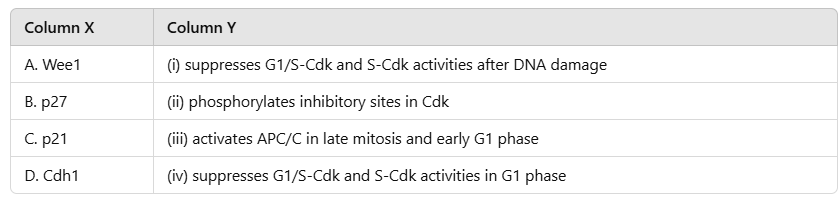
A. Wee1 -Wee1 is a kinase that inhibits cyclin-dependent kinases (Cdk) by phosphorylating them. It regulates the cell cycle by ensuring that cells do not proceed through the cycle when they have DNA damage. This ensures a checkpoint before the cell moves from G1 to S phase or S to G2 phase.
Correct Function: Wee1 corresponds with (ii) phosphorylates inhibitory sites in Cdk.
Explanation: Wee1 inhibits Cdk activity by adding phosphate groups to them, which inhibits the progression of the cell cycle in response to DNA damage.
B. p27- p27 is a Cdk inhibitor that binds to cyclin-Cdk complexes and prevents their activation, particularly during the G1 phase. It plays an important role in regulating cell cycle progression, ensuring that the cell doesn't enter S phase unless it is ready. It specifically helps control the G1/S transition and S-phase progression.
Correct Function: p27 corresponds with (iv) suppresses G1/S-Cdk and S-Cdk activities in G1 phase.
Explanation: p27 functions as an inhibitor of Cdk activity and helps in arresting the cell cycle during G1, preventing premature progression into S phase.
C. p21 - p21 is a Cdk inhibitor activated in response to DNA damage. It helps halt the cell cycle by binding to and inhibiting Cdk-cyclin complexes. It plays a major role in cell cycle arrest and checkpoint control. Additionally, p21 is involved in activating APC/C (Anaphase Promoting Complex) to regulate the transition between mitosis and G1 phase.
Correct Function: p21 corresponds with (i) suppresses G1/S-Cdk and S-Cdk activities after DNA damage.
Explanation: In response to DNA damage, p21 halts cell cycle progression by inhibiting G1/S-Cdk and S-Cdk complexes, ensuring that the cell doesn't progress with damaged DNA.
D. Cdh1 - Cdh1 is a regulator of APC/C (Anaphase Promoting Complex/Cyclosome). It activates APC/C in late mitosis and early G1 phase, leading to the degradation of mitotic cyclins and helping the cell to transition from mitosis to G1. It also ensures the inactivation of cyclins in late mitosis and early G1 phase.
Correct Function: Cdh1 corresponds with (iii) activates APC/C in late mitosis and early G1 phase.
Explanation: Cdh1 activates APC/C in late mitosis, which results in the degradation of mitotic cyclins, allowing the cell to exit mitosis and enter G1 phase. This helps reset the cell cycle.