Correct option is A
1.
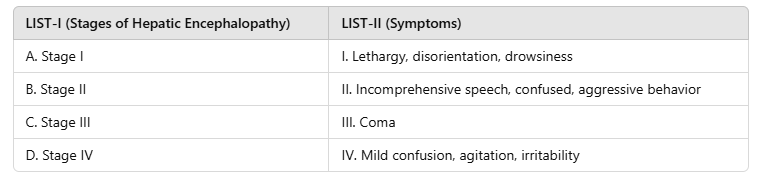
A. Stage I corresponds to
IV. Mild confusion, agitation, irritability. In
Stage I, the patient might experience
mild confusion, irritability, and some agitation, but they are still relatively aware of their surroundings.
2.
B. Stage II corresponds to
I. Lethargy, disorientation, drowsiness. At
Stage II, the patient becomes more disoriented, lethargic, and drowsy, but they are still somewhat responsive.
3.
C. Stage III corresponds to
II. Incomprehensive speech, confused, aggressive behavior. In
Stage III, the patient exhibits
confusion and may engage in
aggressive behavior, often with
incomprehensible speech due to severe cognitive impairment.
4.
D. Stage IV corresponds to
III. Coma. In
Stage IV, the patient has progressed to a
coma, where they are unresponsive and no longer aware of their environment.
Information Booster:
·
Stage I (A): In this
early stage, the symptoms are
mild and might involve
mild confusion,
irritability, and
agitation. The patient is usually still aware of their surroundings.
·
Stage II (B): The patient in
Stage II shows more severe symptoms like
lethargy,
disorientation, and
drowsiness. They may appear confused but can still respond to stimuli.
·
Stage III (C): This stage involves significant
cognitive dysfunction, where patients may exhibit
incomprehensible speech,
aggressive behavior, and a general loss of understanding of their surroundings.
·
Stage IV (D): This is the most severe stage where the patient enters a
coma, no longer responding to external stimuli.
 English
 10 Questions
 20 Marks
 12 Mins