Correct option is D
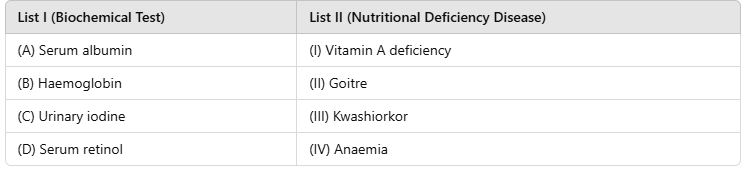
Biochemical tests help diagnose nutritional deficiency diseases by measuring specific biomarkers in the blood or urine. The correct matching of biochemical tests (List I) with their respective nutritional deficiency diseases (List II) is:
· Serum albumin (A) - Kwashiorkor (III): Low serum albumin levels indicate protein malnutrition, which is a key feature of Kwashiorkor, a severe protein deficiency disorder.
· Haemoglobin (B) - Anaemia (IV): Haemoglobin levels measure iron status, and low haemoglobin is a key indicator of iron-deficiency anaemia.
· Urinary iodine (C) - Goitre (II): Iodine levels in urine reflect iodine status, and deficiency leads to goitre, an enlargement of the thyroid gland.
· Serum retinol (D) - Vitamin A deficiency (I): Serum retinol is a marker of Vitamin A levels, and low levels indicate Vitamin A deficiency, which can cause night blindness and xerophthalmia.
Thus, the correct answer is (d) A - III, B - IV, C - II, D - I.
Information Booster:
Biochemical Tests and Their Nutritional Deficiency Indicators:
1. Serum Albumin (Kwashiorkor):
· A protein found in blood plasma.
· Low levels indicate protein-energy malnutrition (PEM), seen in Kwashiorkor.
2. Haemoglobin (Anaemia):
· Measures iron levels in red blood cells.
· Low levels cause fatigue, weakness, and breathlessness, characteristic of anaemia.
3. Urinary Iodine (Goitre):
· Reflects iodine intake and thyroid function.
· Low iodine causes thyroid gland enlargement (goitre) and hypothyroidism.
4. Serum Retinol (Vitamin A Deficiency):
· Retinol is a major form of Vitamin A in blood.
· Low levels lead to night blindness, dry eyes (xerophthalmia), and impaired immunity.
 English
 10 Questions
 20 Marks
 12 Mins