






Correct option is A
1.
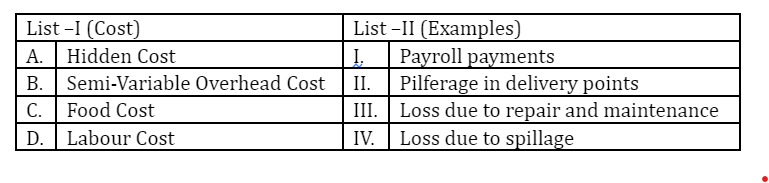
(A) Hidden Cost → (IV) Loss due to spillage
·
Hidden costs are indirect costs that are not easily identifiable but can impact the overall cost structure. One example of hidden costs is
loss due to spillage, where products or materials are lost during the handling or processing phase, but this cost is not directly visible in financial statements.
2.
(B) Semi-Variable Overhead Cost → (III) Loss due to repair and maintenance
·
Semi-variable overhead costs consist of both fixed and variable components. An example of this is the
loss due to repair and maintenance, which can vary depending on the usage of equipment but still incurs a base cost regardless of activity levels.
3.
(C) Food Cost → (II) Pilferage in delivery points
·
Food cost refers to the expense incurred for purchasing food materials. One of the common issues contributing to increased food costs is
pilferage (theft) at delivery points, where food items may be stolen or lost, affecting the overall food cost.
4.
(D) Labour Cost → (I) Payroll payments
·
Labour cost is directly associated with
payroll payments, where the expenses related to wages, salaries, and other employee compensation are categorized.
Information Booster:
Costs in management accounting are classified into different categories based on their behavior, visibility, and direct or indirect impact on the operations of a business. Understanding these cost classifications helps in better budgeting and financial control.
·
Hidden Costs: Costs that are not directly accounted for but still affect profitability, such as material losses, delays, or inefficiencies.
·
Semi-Variable Overhead Costs: Expenses that have both fixed and variable components, making them partly dependent on business activity levels.
·
Food Costs: Include all expenses related to purchasing food items, and pilferage is a significant issue that can inflate food costs.
·
Labour Costs: Refers to direct payments made to employees, including wages, bonuses, and benefits, which are recorded as payroll expenses.
 English
 10 Questions
 20 Marks
 12 Mins


