






Correct option is C
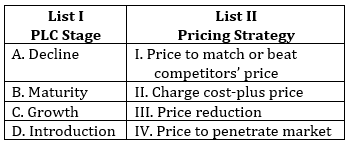
Decline (List I) - iii. Price reduction (List II) During the decline stage of the product life cycle (PLC), the demand for the product decreases. To attract remaining customers and maintain sales, companies often reduce prices to remain competitive. b. Maturity (List I) - i. Price to match or beat competitors' price (List II) In the maturity stage of the PLC, competition intensifies, and companies may adopt pricing strategies to match or beat competitors' prices. This helps to retain market share and attract price-sensitive customers. c. Growth (List I) - iv. Price to penetrate the market (List II) During the growth stage of the PLC, companies aim to capture market share and expand their customer base. To achieve this, they may set lower prices than competitors to attract new customers and gain market penetration. d. Introduction (List I) - ii. Charge cost-plus price (List II) In the introduction stage of the PLC, companies often charge a cost-plus price, which means they set prices by adding a markup to cover costs and generate a profit. This approach helps to recover initial investments and establish the product in the market.
 English
 10 Questions
 20 Marks
 12 Mins


