






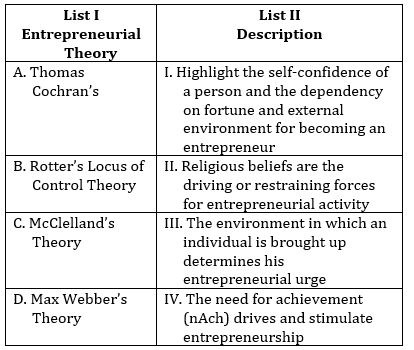
Correct option is A
1. Thomas Cochran’s Theory → III
· Thomas Cochran's Theory emphasizes that the environment in which an individual is brought up significantly influences their entrepreneurial tendencies. Cultural values, role models, and social influences shape entrepreneurial behavior.
· Matches III: "The environment in which an individual is brought up determines his entrepreneurial urge."
2. Rotter’s Locus of Control Theory → I
· Rotter’s Locus of Control Theory focuses on an individual's perception of control over life events. Entrepreneurs with a strong internal locus of control believe in self-determination, while those with an external locus of control depend on fate and external factors.
· Matches I: "Highlight the self-confidence of a person and the dependency on fortune and external environment for becoming an entrepreneur."
3. McClelland’s Theory → IV
· David McClelland's Theory suggests that the Need for Achievement (nAch) is the primary driver of entrepreneurship. Entrepreneurs with a high need for achievement are more likely to take calculated risks and strive for excellence.
· Matches IV: "The need for achievement (nAch) drives and stimulates entrepreneurship."
4. Max Weber’s Theory → II
· Max Weber's Theory highlights the role of religion and cultural beliefs in shaping entrepreneurship. He argued that religious values, such as those in Protestant ethics, promote hard work and business success.
· Matches II: "Religious beliefs are the driving or restraining forces for entrepreneurial activity."
 English
 10 Questions
 20 Marks
 12 Mins


