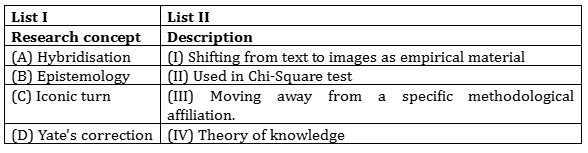
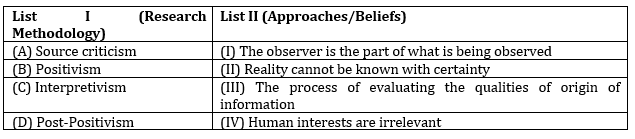
Correct option is D
Convenience sampling is a non-probability sampling method where researchers select participants based on their easy availability, accessibility, and willingness to participate. It is often referred to as an accidental sample or haphazard sample because the researcher chooses subjects based on convenience rather than a structured plan.
- This method is commonly used in exploratory research, pilot studies, and quick data collection when a random sample is difficult to obtain.
- Since it does not involve random selection, the results may lack generalizability to a larger population.
Information Booster:
- Purposive Sampling: Researchers intentionally select participants based on specific characteristics relevant to the study.
- Quota Sampling: Involves selecting participants proportionally from different subgroups based on predefined quotas.
- Stratified Random Sampling: A probability sampling method where the population is divided into strata (subgroups), and random samples are drawn from each stratum for better representation.
 English
 10 Questions
 20 Marks
 12 Mins