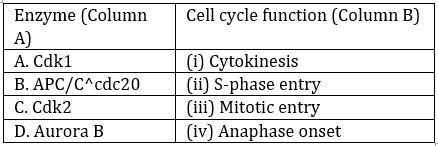
Correct option is C
DNA replication in eukaryotic cells is tightly regulated and restricted to the S phase of the cell cycle to ensure genome integrity and prevent re-replication. The minichromosome maintenance (MCM) helicase complex plays a crucial role in this regulation.
- Pre-replicative complex (Pre-RC) formation occurs in the G1 phase, where the MCM helicases are loaded onto DNA but remain inactive.
- MCM helicase activation occurs only in the S phase, ensuring replication initiates only at the right time.
- Once activated, MCM helicases unwind DNA, allowing the replication fork to progress.
- Option (1) DNA Polymerase: Present throughout the cycle but activated in the S phase.
- Option (2) ORC Recognition: ORC binds DNA continuously, but MCM activation is the key regulatory step in S phase.
- Option (3) MCM Activation in S Phase: This is the correct answer since DNA replication is initiated only when MCM helicases become active.
- Option (4) MCM Activation in G1 Phase: MCM binding happens in G1, but activation occurs only in the S phase.
Information Booster
- DNA Replication Control: Eukaryotic cells ensure that DNA is replicated once per cycle by controlling MCM helicase activation.
- Pre-replicative Complex (Pre-RC): The ORC, Cdc6, and Cdt1 recruit MCM helicases to replication origins in the G1 phase.
- MCM Activation: In the S phase, CDKs and DDK phosphorylate MCM helicases, leading to replication initiation.
- Replication Licensing: Pre-RC formation in G1 licenses DNA for replication, but actual replication occurs only in the S phase.
- Cyclin-CDK Regulation: CDK activity is low in G1 (allowing MCM loading) and high in S phase (triggering MCM activation and replication).
- Replication Initiation: MCM helicases create replication forks by unwinding DNA and recruiting DNA polymerase for synthesis.
- Prevention of Re-replication: Once replication starts, Cdc6 and Cdt1 are degraded, preventing the reformation of Pre-RC within the same cycle.