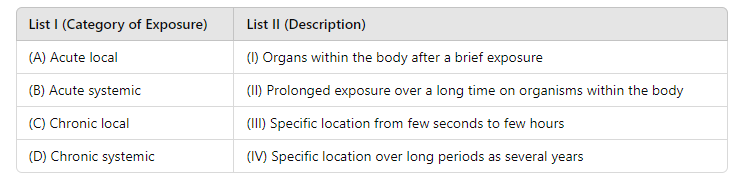
Correct option is D
Toxicology study: This type of study focuses on understanding the harmful effects of substances, chemicals, or toxins, not directly on the disease exposure and commonalities in a population.
Correlation study: This study examines the relationship between two variables but does not specifically focus on identifying individuals with a specific disease first.
Cohort study: In a cohort study, individuals are grouped based on exposure factors, and then their outcomes (disease or health status) are observed. While cohort studies can be used for disease exposure studies, they do not specifically begin with identifying individuals who already have the disease.
Case-control study: This type of epidemiological study identifies individuals who have a specific disease (cases) and compares them with individuals who do not have the disease (controls). The researchers then look for common exposures or risk factors that might explain why the cases have the disease. This study is the most appropriate for this scenario.
Information Booster: 1. Case-control studies are often used to identify potential causes or risk factors for a particular disease. The "case" group includes individuals who have the disease, and the "control" group includes individuals who are similar in other ways but do not have the disease.
2. Cohort studies are prospective and focus on groups of individuals with common exposure to certain factors. They observe how these groups develop over time, looking for differences in disease outcomes.
3. Correlation studies focus on the relationship between two variables but cannot establish causality or provide an understanding of how one factor causes a disease in a specific group of individuals.
4. Toxicology studies focus on the health impacts of exposure to toxic substances and are often used to understand long-term effects, rather than disease diagnosis and exposure analysis.
 English
 10 Questions
 20 Marks
 12 Mins