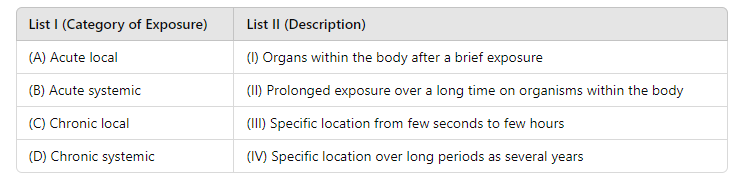
Correct option is A
Introduction
The way an organism responds to a toxic chemical is governed by a concept called Toxicokinetics (or Pharmacokinetics in pharmacology). This refers to how a substance moves into, through, and out of the body.
Information Booster
These four distinct phases are universally known in science by the acronym ADME:
(A) Absorption: This is the process by which the toxic chemical enters the organism's bloodstream from the site of exposure (such as the skin, lungs, or gastrointestinal tract).
(B) Distribution: Once absorbed, the chemical is transported via the blood to various tissues, organs, and cells throughout the body. This determines where the chemical will accumulate and potentially cause harm.
(E) Metabolism: Also known as the detoxification process, this primarily happens in the liver. The body chemically alters the toxic substance into new compounds (metabolites) to make it less toxic and more water-soluble so it can be easily flushed out.
(D) Excretion: This is the final step where the original chemical or its metabolites are eliminated from the body, most commonly through urine (kidneys), feces (GI tract), exhaled air (lungs), or sweat.
Additional knowledge:
While "Biotransformation" is a highly accurate scientific term for the chemical changes that occur to a toxicant, in the context of the classic "four processes" framework, the broader term Metabolism is standard to complete the ADME acronym.
Biotransformation is simply the specific biological mechanism that takes place during the metabolism phase.
 English
 10 Questions
 20 Marks
 12 Mins