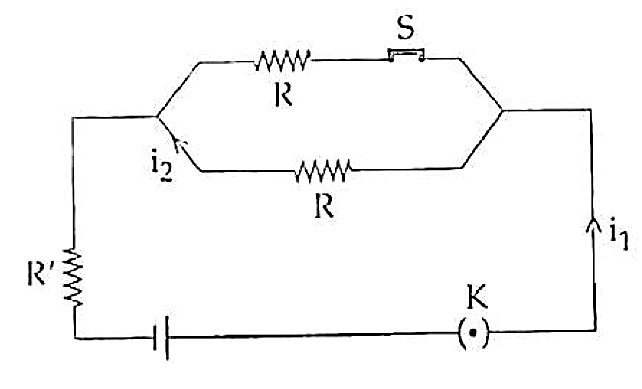
Correct option is D
The correct answer is (d) It gets halved.
· According to Ohm’s Law, the current III flowing through a conductor is directly proportional to the potential difference VVV applied across its ends, provided the temperature and resistance remain constant.
I=VR
where:
· I = Current
· V = Potential Difference
· R = Resistance
· If the potential difference VVV is halved and the resistance RRR remains constant, the current will also reduce to half its original value.
· This linear relationship means that when the voltage across the conductor decreases, the current flowing through it decreases in the same proportion.
Information Booster:
· Ohm's Law: States that V=IR , where VVV is the voltage, III is the current, and RRR is the resistance.
· Resistance (R): The opposition offered by the material to the flow of electric current, measured in ohms (Ω).
· Direct Proportionality: In Ohm's Law, current and potential difference are directly proportional, meaning if one decreases, the other decreases by the same factor, provided resistance is constant.
 English
 100 Questions
 100 Marks
 90 Mins