Correct option is D
Explanation:
B is correct: Circular DNA found in mitochondria, viruses, and bacteria is indeed negatively supercoiled. This is the common feature of circular DNA in these organisms.
C is correct: During transcription, RNA polymerase generates positive super helical tension in the DNA ahead of it and negative super helical tension behind it due to its movement along the DNA.
A is incorrect: DNA supercoiling does regulate gene expression, but it also plays an important role in genome organization, so it is not accurate to say it does not affect genome organization.
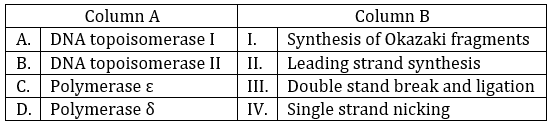
D is incorrect: Human topoisomerase I makes a transient break in only one strand of the DNA, not both, to relieve supercoiling, so this statement is wrong.
E is incorrect: Topoisomerase II cuts both strands of the DNA, not just a single strand. It allows for relaxation by making a break in both strands, so this statement is also incorrect.
Information Booster:
Circular DNA in mitochondria, bacteria, and viruses is negatively supercoiled to stabilize the structure and help in DNA processes.
RNA polymerase generates supercoiling in DNA: positive supercoiling ahead and negative supercoiling behind, which is essential for transcription.
Topoisomerase I relieves supercoiling by breaking only one strand of the DNA.
Topoisomerase II relieves supercoiling by making a break in both strands of DNA.
DNA supercoiling impacts gene expression and genome organization, both of which are crucial for maintaining cellular functions.
Additional Information:
Statement A: DNA supercoiling regulates both gene expression and genome organization, so stating it does not impact genome organization is incorrect.
Statement D: Topoisomerase I makes a break in only one strand of the DNA, while topoisomerase II cuts both strands to relieve supercoiling, making statement D incorrect.
Statement E: The mechanism described for topoisomerase II is inaccurate because it cuts both strands, not just a single strand.