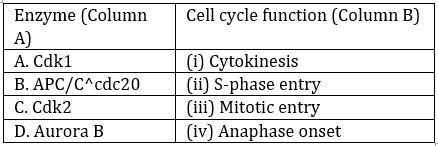
Correct option is C
Explanation:
Cdc20 (A): Cdc20 is a key activator of the APC/C complex. It plays an essential role in the metaphase to anaphase transition by activating APC/C, which leads to the degradation of securin, allowing separase to cleave cohesin and enable sister chromatids to separate.
APC/C (B): APC/C (Anaphase Promoting Complex/Cyclosome) is crucial for the transition from metaphase to anaphase. It is activated by Cdc20 and targets securin for degradation. The degradation of securin allows separase to cleave cohesin and facilitate chromatid separation.
Separase (C): Separase is the enzyme responsible for cleaving cohesin, the protein complex that holds sister chromatids together. It is activated during the metaphase-anaphase transition and is essential for the separation of chromatids.
Cyclin A (D): Cyclin A is involved in regulating the cell cycle but does not directly participate in cohesin removal during the metaphase to anaphase transition. Its primary role is in the regulation of CDK2 activity, which helps in DNA replication and cell cycle progression, but not in cohesin cleavage.
Information Booster:
Cdc20 activates APC/C, leading to the degradation of securin.
APC/C is a complex that targets specific proteins for degradation, playing a key role in the transition from metaphase to anaphase.
Separase cleaves cohesin, enabling the separation of sister chromatids.
Cyclin A regulates CDK2 during cell cycle progression but does not directly affect cohesin removal.