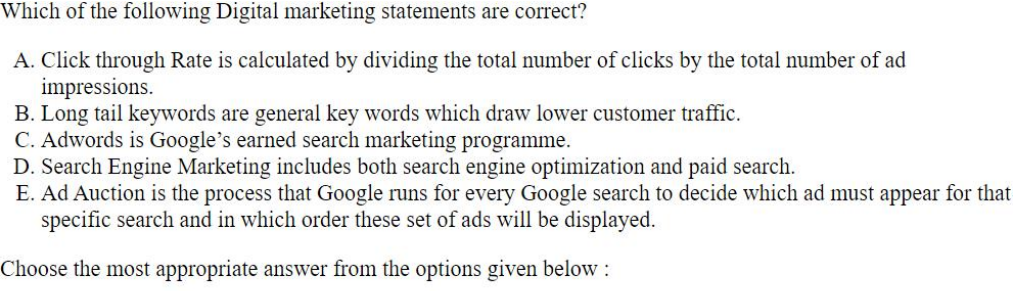
Correct option is A
Complex buying behaviour occurs when:
- Consumers face high involvement in the purchasing decision, typically because the product is expensive, infrequent, or highly significant (e.g., a car or a house).
- There are significant perceived differences between brands, requiring extensive research and evaluation by the buyer.
- Consumers gather detailed information about products, compare attributes, and evaluate alternatives before making a decision.
2. Dissonance-reducing buying behaviour: Occurs in high-involvement purchases but with few perceived differences between brands. Buyers may experience post-purchase dissonance (regret).
3. Habitual buying behaviour: Characterized by low involvement and little brand differentiation; buying decisions are routine (e.g., purchasing milk or bread).
4. Variety-seeking buying behaviour: Happens when involvement is low, but there are significant brand differences, leading consumers to switch brands for variety or experimentation.
Thus, the behavior described matches Complex Buying Behaviour.
Information Booster:
Key Factors in Complex Buying Behaviour:
- High Involvement: Consumers invest time and effort due to the importance of the purchase.
- Significant Brand Differences: Clear distinctions between product features, quality, or price make comparisons necessary.
- Consumer Process: Includes extensive problem recognition, information search, evaluation of alternatives, and post-purchase evaluation.
Additional Knowledge:
- Option B (Dissonance-reducing buying behaviour): Incorrect because it applies to situations with few brand differences, unlike the given scenario.
- Option C (Habitual buying behaviour): Incorrect because habitual buying involves low involvement and minimal decision-making effort.
- Option D (Variety-seeking buying behaviour): Incorrect because variety-seeking occurs in low-involvement purchases with frequent brand-switching.
Complex buying behaviour is crucial for industries dealing with expensive, high-stakes, or differentiated products.
 English
 10 Questions
 20 Marks
 12 Mins