Correct option is C
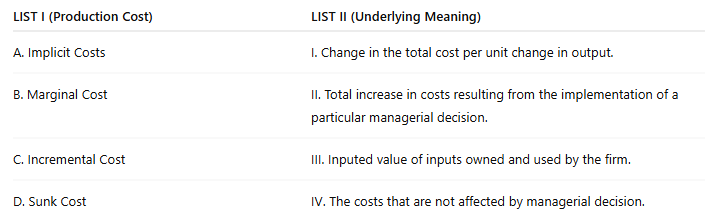
The correct match is:
A. Implicit Costs represent the imputed value of inputs owned and used by the firm rather than purchased from the market. These are opportunity costs related to the use of owner-supplied resources and do not involve direct cash payment. Therefore, implicit costs match with III.
B. Marginal Cost is defined as the change in total cost that arises from producing one additional unit of output. It measures how costs vary with small changes in production level. Hence, marginal cost matches with I.
C. Incremental Cost refers to the total increase in costs resulting from the implementation of a particular managerial decision. It considers the additional costs specifically attributable to a decision, matching with II.
D. Sunk Cost is the cost that has already been incurred and cannot be recovered or affected by future managerial decisions. It is irrelevant for decision-making, so sunk cost matches with IV.
Information Booster:
Implicit Costs: Reflect opportunity costs of resources owned by the firm and not directly paid for in cash, important in economic profit calculation.
Marginal Cost: Helps firms decide output levels by comparing the additional cost to additional revenue; critical for profit maximization.
Incremental Cost: Used in decision-making to evaluate the financial impact of alternative actions, focusing only on relevant costs.
Sunk Cost: Should be ignored in future decisions since these costs remain unchanged regardless of the choice made.
Understanding these cost concepts assists managers in making economically sound decisions by distinguishing relevant costs from irrelevant ones.
 English
 10 Questions
 20 Marks
 12 Mins