Correct option is C
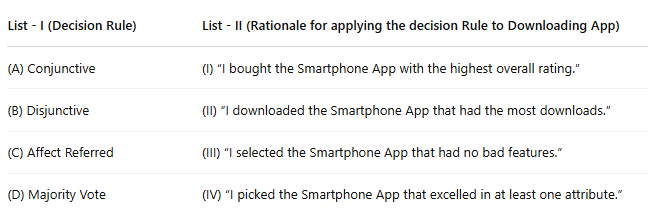
(A) Conjunctive → (III): The conjunctive rule sets minimum required levels for each attribute. A product is chosen only if it meets or exceeds all minimum criteria. So, selecting an app that "had no bad features" reflects this rule, as the decision-maker is eliminating any option with below-threshold performance on any attribute.
(B) Disjunctive → (IV): The disjunctive rule allows selection based on excelling in at least one attribute, regardless of performance on others. Hence, “picked the Smartphone App that excelled in at least one attribute” is aligned.
(C) Affect Referred → (I): This rule is emotion-driven—people select based on an overall positive feeling or general impression. “Bought the Smartphone App with the highest overall rating” fits here, as it reflects an emotional, overall impression rather than specific analysis.
(D) Majority Vote → (II): Here, the decision is based on aggregation—like popularity or social proof. Choosing the app “that had the most downloads” reflects this rule as it assumes collective choice implies quality.
Information Booster:
Conjunctive Rule filters out all alternatives with any poor attribute, ensuring only balanced products are selected.
It’s commonly used in risk-averse decision-making where minimum standards must be met across the board.
Disjunctive Rule focuses on strengths—at least one exceptional attribute can justify selection.
Affect Referred Rule is driven by overall impression or emotional response rather than technical criteria.
Majority Vote Rule relies on social influence, assuming what is popular is also the best.
These rules reflect real-world consumer behavior patterns in marketing, e-commerce, and app selection.
Understanding these rules helps in designing better recommendation systems and consumer targeting strategies.
 English
 10 Questions
 20 Marks
 12 Mins