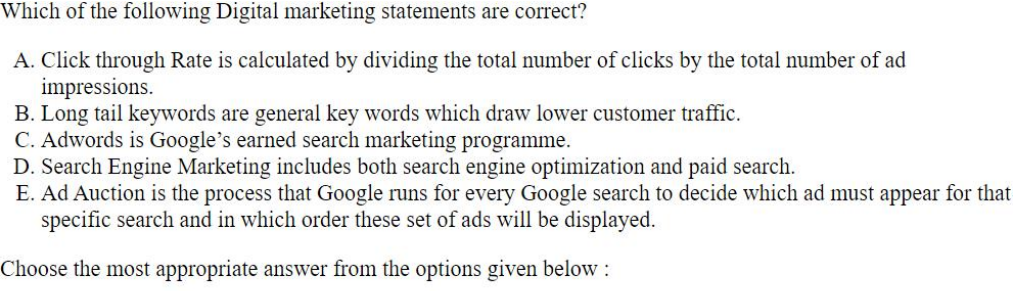
Correct option is A
Introduction:
The correct answer is 1. ₹ 6060.
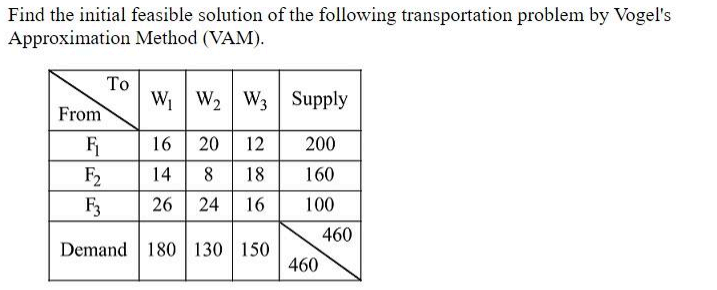
In Operations Research, the Vogel's Approximation Method (VAM) is a heuristic framework used to find an Initial Feasible Solution (IFS) to a transportation problem. It operates by minimizing the penalty cost resulting from a failure to allocate units to the lowest-cost cells. By systemically computing row and column penalties (the difference between the two lowest costs), identifying the maximum penalty, and making strategic allocations to the least expensive cell in that row or column, we achieve an optimized base distribution layout. yields an optimal initial transportation cost of ₹ 6060.
Step-by-Step VAM Allocation Process:
Step 1: Calculate Initial Penalties
Row Penalties:
Column Penalties:
Step 2: First Allocation
The maximum penalty is 12 in column . The cell with the lowest cost in is with a cost of 8.
Allocate units to .
Demand for is fully satisfied (). Remaining supply at . Cross out column .
Step 3: Second Allocation (Recalculate Penalties for remaining $W_1, W_3$)
Row Penalties: ; ; .
Column Penalties: ; .
The maximum penalty is 10 in row . The lowest cost cell in is with a cost of 16.
Allocate units to .
Supply at is exhausted (). Remaining demand for . Cross out row .
Step 4: Third Allocation (Recalculate Penalties for rows $F_1, F_2$ and columns $W_1, W_3$)
Row Penalties: .
Column Penalties: .
The maximum penalty is 6 in column $W_3$. The lowest cost cell in $W_3$ is $(F_1, W_3)$ with a cost of 12.
Allocate units to .
Demand for is fully satisfied (). Remaining supply at . Cross out column .
Step 5: Final Allocations (Only Column $W_1$ remains)
For cell with cost 16: Allocate remaining supply of units. (Remaining demand of ).
For cell with cost 14: Allocate remaining supply of units. (Demand of becomes ).
Step 6: Total Cost Calculation
Vogel's Approximation Method (VAM): Recognized as the most efficient heuristic method for obtaining an initial feasible solution because it yields a starting cost very close to (and sometimes matching) the absolute optimal solution.
The Concept of Penalty: The penalty represents the economic opportunity loss or opportunity cost incurred if the allocator misses out on the best cell and is forced to use the next best available alternative path.
Feasibility Check Rule: For a transportation problem to have a non-degenerate basic feasible solution, the total number of occupied allocations must exactly equal , where $m$ is the number of origins (rows) and $n$ is the number of destinations (columns). In this matrix, allocations, which perfectly satisfies the requirement.
Why Option 2 is incorrect: ₹ 6660 is an over-calculated value that typically arises if a student mistakenly allocates units across columns or rows using a generic structural matrix loop without properly dropping completed constraint headers.
Why Option 3 is incorrect: ₹ 6000 is an artificial mathematical rounding floor trap. VAM relies on precise multiplicative products of cell coefficients and structural units, which do not break down cleanly into an exact flat thousands marker here.
Why Option 4 is incorrect: ₹ 6600 represents a typical value obtained if an aspirant uses the simpler Least Cost Method (LCM) or North-West Corner Method (NWCM), which do not incorporate penalty opportunity evaluations and consequently generate less cost-efficient initial solutions than VAM.
 English
 10 Questions
 20 Marks
 12 Mins