






Correct option is B
The lattice energy is the energy change upon formation of one mole of a crystalline ionic compound from its constituent ions, which are assumed to initially be in the gaseous state. It is a measure of the cohesive forces that bind ionic solids. The size of the lattice energy is connected to many other physical properties including solubility, hardness, and volatility.
Born and Landé proposed that the lattice energy could be derived from the electric potential of the ionic lattice and a repulsive potential energy term.
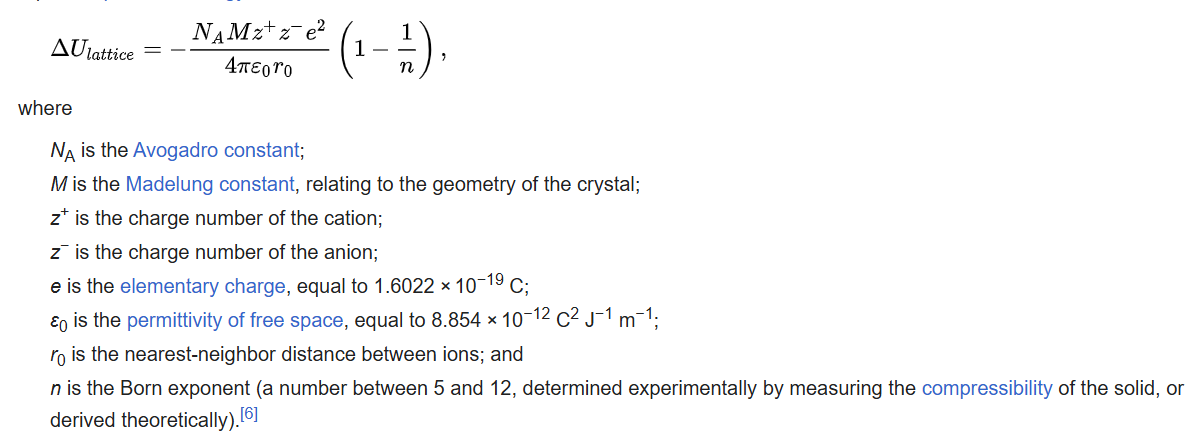
In this context:
1. MgO has a higher lattice energy because magnesium (Mg2+) and oxide (O2-) ions have smaller ionic radii than calcium (Ca2+), barium (Ba2+), and oxide (O2-) ions, leading to a stronger electrostatic attraction.
2. The lattice energy decreases down the group in the periodic table as ionic radii increase
Information Booster
· For ionic compounds with the same type of ions (e.g., Group 2 oxides), the lattice energy decreases as the ionic size of the metal increases because the ions cannot pack as closely.
· MgO has the highest lattice energy among Group 2 oxides like CaO and BaO because Mg2+ is the smallest cation in the group, leading to a stronger interaction with O2-.
 English
 150 Questions
 150 Marks
 150 Mins


