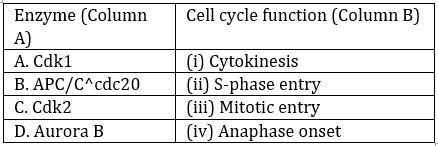
Correct option is C
Explanation:
- Schizosaccharomyces pombe (S. pombe) is a model organism for studying the cell cycle.
- Cdc2 (Cyclin-dependent kinase 1, CDK1 in higher eukaryotes) is a key regulator of the cell cycle in S. pombe.
- Cdc2 is required for both the G1 to S phase transition and the G2 to M phase transition.
- A temperature-sensitive mutant of Cdc2 would fail to progress through these checkpoints, leading to cell cycle arrest at both transitions (G1/S and G2/M).
- Since the phenotype described includes arrest at both G1/S and G2/M, this suggests a defect in Cdc2 function.
Thus, the correct answer is Cdc2 only (option 3).
Information Booster
- Cdc2 is the homolog of CDK1 in eukaryotic cells, and it is essential for cell cycle progression.
- At the G1/S checkpoint, Cdc2 interacts with Cyclin C to initiate DNA replication.
- At the G2/M checkpoint, Cdc2 interacts with Cyclin B to promote mitotic entry.
- Temperature-sensitive mutations in Cdc2 cause cells to arrest at G1/S and G2/M due to failure in kinase activity.
- Loss-of-function mutations in Cdc2 result in cell cycle arrest, whereas hyperactive mutations cause premature mitosis.
- S. pombe was instrumental in discovering CDKs, which earned Leland Hartwell, Paul Nurse, and Tim Hunt the 2001 Nobel Prize in Physiology or Medicine.
- Cdc2 phosphorylation status (by Wee1 and Cdc25) regulates mitotic entry.
Additional Information
- Option (1) Clb1 → Incorrect, as Clb1 is a cyclin involved in mitosis in Saccharomyces cerevisiae (not S. pombe).
- Option (2) Cyclin B → Incorrect, as Cyclin B alone does not regulate the G1/S transition; it primarily regulates the G2/M transition.
- Option (4) Cdc2 and Clb3 → Incorrect, because Clb3 is a cyclin from S. cerevisiae, not S. pombe.