Correct option is D
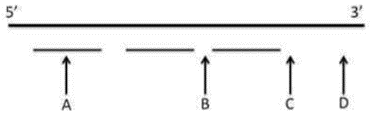
To determine which combinations of primers can amplify the provided DNA sequence, we will analyze each primer for complementarity to the target sequence.
Given DNA Sequence:
5’ –ATGACGATGACGAGACGATGCAGATGATAGCAGTAGCGAATGAC – 3’
Primers:
A. 5’ – TACTGCT – 3’
B. 5’ – CAGTAAG – 3’
C. 5’ – ATGACGA – 3’
D. 5’ – GTCATTC – 3’
E. 5’ – TCGTCAT – 3’
F. 5’ – GAATGAC – 3’
Analysis of Each Primer:
Primer A: 5’ – TACTGCT – 3’
This primer would bind to the complementary sequence of the original DNA (from 3’ to 5’), which is 5’ – AGCAGTA - 3’.
The exact complementary sequence is not present in the given DNA strand.
Primer B: 5’ – CAGTAAG – 3’
This primer would bind to the complementary sequence 5’ – CTACTG – 3’.
The exact complementary sequence is not present in the given DNA strand.
Primer C: 5’ – ATGACGA – 3’
This primer exactly matches the beginning of the DNA sequence (5’ – ATGACGA – 3’).
Therefore, Primer C can bind to the 5’ end of the original sequence.
Primer D: 5’ – GTCATTC – 3’
This primer would bind to the complementary sequence 5’ – GAATGAC – 3’.
This sequence is present toward the end of the given DNA sequence at the 3’ end, allowing Primer D to bind at the 3’ end.
Primer E: 5’ – TCGTCAT – 3’
This primer would bind to the complementary sequence 5’ – ATGACGA – 3’, which appears in the original DNA. However, Primer C binds more effectively at the 5’ end of the DNA.
Primer F: 5’ – GAATGAC – 3’
This primer exactly matches the complementary sequence of the 3’ end of the DNA sequence (5’ – GTCATTC – 3’), meaning it can bind at the 3’ end.
The correct combination of primers that could amplify the DNA sequence is C and D.