
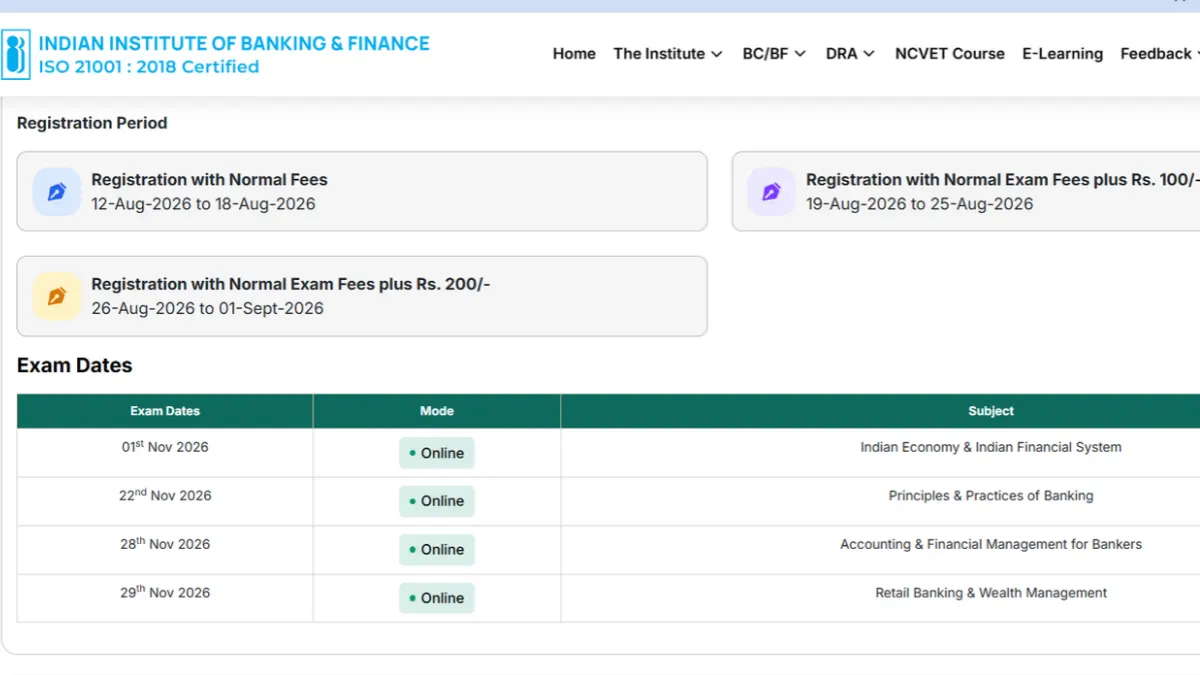
JAIIB Exam Analysis 2026 for 1 November is now out. IIBF conducted the Indian Economy & Indian Financial System paper in three shifts starting from 9:30 AM to 11:30 AM, 12:15 PM to 2:15 PM and 3:00 PM to 5:00 PM. The paper had 100 MCQs for 100 marks with exam duration of 2 hours.
Candidates who appeared for the exam can check the detailed shift wise exam review, overall difficulty level, and subject wise analysis in this article.The analysis will help candidates understand the types of questions asked and the important topics covered in the examination.
In this article, we provide the complete details on the JAIIB exam analysis for 1 November, including the shift wise exam review, important topics, passing marks, and preparation tips for the remaining papers.
JAIIB Exam Analysis 2026
The JAIIB Exam Analysis 2026 includes important details such as the overall difficulty level, section wise review, types of questions asked, and candidates’ feedback. The examination is conducted for banking employees seeking the JAIIB qualification. Candidates can use this analysis to evaluate their performance and understand the examination trend. It will also help candidates appearing for the remaining papers scheduled for 22, 28, and 29 November 2026.
JAIIB Exam Analysis 2026: 1 November Overview
| Particular | Details |
| Exam Conducting Body |
Indian Institute of Banking and Finance (IIBF)
|
| Exam Date | 1 November 2026 |
| Paper |
Indian Economy & Indian Financial System (IE & IFS)
|
| Mode |
Online (Computer-Based Test)
|
| Total Questions | 100 MCQs |
| Maximum Marks | 100 |
| Duration | 2 hours |
| Number of Shifts | 3 |
| Overall Difficulty Level | Moderate |
| Official Website | www.iibf.org.in |
JAIIB Exam Shift Timings 2026 (1 November)
The JAIIB examination on 1 November 2026 was conducted in three different shifts as follows:
| Shift | Reporting Time | Exam Timing |
| 1st Shift | 9:00 AM |
09:30 AM – 11:30 AM
|
| 2nd Shift | 11:45 AM |
12:15 PM – 02:15 PM
|
| 3rd Shift | 2:30 PM |
03:00 PM – 05:00 PM
|
JAIIB Exam Review 1 November 2026: Shift-wise
The shift-wise analysis helps candidates understand what the question trend and difficulty level was across the three shfits for the Indian Economy & Indian Financial System (IE & IFS) paper conducted on 1 November 2026. The analysis has been prepared based on our expert team’s analysis and candidate feedback.
| Shift | Difficulty Level |
| Shift 1 (9:30 AM – 11:30 AM) | Moderate to Tough |
| Shift 2 (12:15 PM – 02:15 PM) | Moderate to Tough |
| Shift 3 (3:00 PM – 05:00 PM) | Moderate to Tough |
JAIIB Passing Marks 2026
Candidates appearing for the JAIIB examination must follow the prescribed qualifying criteria laid down by the IIFB in order to gain their certification. Candidates need to score:
- 50 marks out of 100 in each subject, OR
- At least 45 marks in each subject with an overall aggregate of 50% in a single attempt.
JAIIB IE & IFS Questions Asked Today in Shift 1
Below, you can find the important topics asked in the Indian Economy & Indian Financial System paper from various sections.
| Section | Topic |
Important Subtopics
|
| Banking Regulations and RBI | FDI Limit in Private Banks |
Foreign Direct Investment limits in private sector banks
|
| RBI Board Composition |
Number of members and composition of the RBI Central Board
|
|
| Section 22 of RBI Act |
Provisions related to the issue of banknotes by RBI
|
|
| RBI Act, 1934 |
Important provisions and regulations
|
|
| Banking Regulation Act |
Important provisions of the Act
|
|
| Full-Time Directors in Banks |
Eligibility criteria and appointment rules
|
|
| RRB Shareholding Pattern |
Central Government (50%), State Government (15%) and Sponsor Bank (35%)
|
|
| PSL Targets for Weaker Sections |
Priority Sector Lending targets for SFBs and SCBs
|
|
| IFCI |
Establishment year and main purpose
|
|
| Financial Institutions and Banking Schemes | NaBFID Board Composition |
Structure and number of board members
|
| Government Stake in NaBFID |
Central Government’s shareholding
|
|
| SMILE Scheme |
Objectives, eligibility and financial assistance limits
|
|
| Microfinance Institutions (MFIs) |
Meaning, functions and regulations
|
|
| NARCL (Bad Bank) |
Bond structure and transfer of bad loans
|
|
| EASE Reforms |
Full form and objectives
|
|
| SFURTI Scheme |
Full form, objectives and benefits
|
|
| Derivative Products |
Identification and types of derivatives
|
|
| Stock Exchanges |
Establishment years of BSE (1875), CSE (1908), OTCEI (1990), NSE (1992), Metropolitan Stock Exchange (2012), NSE IFSC (2016) and India INX (2017)
|
|
| Benchmark Rates |
Meaning and features of SOFR and SONIA
|
|
| REITs |
Roles of Sponsor, Trustee and SPV
|
|
| Green Bonds |
Meaning, purpose and features
|
|
| Green Shoe Option |
Meaning and purpose
|
|
| Factoring |
Single factoring and international factoring
|
|
| TReDS |
Meaning and working of Trade Receivables Discounting System
|
|
| Leasing and Hire Purchase |
Differences between leasing and hire purchase
|
|
| LPT |
Full form and related concepts
|
|
| Insurance Ombudsman |
Role, responsibilities and jurisdiction
|
|
| Insurance Basics |
Important insurance rules and concepts
|
|
| Economy and Financial Calculations | GDP Calculation |
Numerical questions based on Gross Domestic Product
|
| NNP |
Meaning, formula and related concepts
|
|
| Revenue Deficit |
Meaning and numerical calculations
|
|
| Fiscal Deficit |
Formula and meaning
|
|
| Money Supply |
Different measures, including M1 and M3
|
|
| M3 Formula |
Relationship between M1 and time deposits with banks
|
|
| CPI and WPI |
Meaning, differences and measurement of inflation
|
|
| Quinary Sector |
Meaning and role in high-level decision-making
|
|
| Agriculture Sector |
Classification under the primary sector
|
|
| Reasons for Migration |
Causes and factors responsible for migration
|
|
| MSME and Economic Classification | Medium Enterprise Classification |
Investment and annual turnover criteria
|
| Government Schemes and Infrastructure | Parvatmala Pariyojana |
Objectives and important features
|
| Bharatmala Pariyojana |
Road and highway infrastructure development
|
|
| PMSBY |
Eligibility, insurance coverage and benefits
|
|
| PMJJBY |
Eligibility, premium and insurance benefits
|
|
| Atal Pension Yojana (APY) |
Eligibility, contribution and pension benefits
|
|
| CSR and Other Topics | CSR Rules |
Corporate Social Responsibility provisions and penalties
|
| UCRF |
Full form and associated financial or banking concepts
|
JAIIB IE & IFS Questions Asked in Shift 2
Banking and Financial Regulations
| Topic |
Important Questions
|
| Banking Legislation |
Which Act governed banks before the Banking Regulation Act?
|
| RBI Act |
Under which section of the RBI Act is the authority to issue banknotes provided? (Section 22)
|
| RBI Central Board |
What is the minimum number of meetings of the RBI Central Board required per year?
|
| Cooperative Banks |
Which is NOT a supervisory authority for banking operations of Multi-State Urban Cooperative Banks?
|
| Bancassurance |
What is the minimum net worth required for a bank to establish a subsidiary or joint venture for conducting insurance business with risk participation?
|
| Bancassurance |
What is the meaning of the arm’s length principle in bancassurance?
|
| Priority Sector Lending |
Which categories are covered under Priority Sector Lending (PSL)?
|
| Pension Administration |
Which department administers pension-related matters?
|
| EPFO |
Which is the nodal ministry for EPFO?
|
| PFRDA |
What is the role of PFRDA?
|
Financial Markets and Investments
| Topic |
Important Questions
|
| Money Market |
Which of the following is a private non-bank money market instrument?
|
| Money Market |
Which organisation manages money market benchmark rates in India?
|
| US Dollar Index |
What is the USDX (US Dollar Index) related to?
|
| Credit Rating |
What is a benefit of credit rating from the perspective of investors and financial markets?
|
| RBI Liquidity Management |
What is VRRR (Variable Rate Reverse Repo)?
|
| InvITs |
Who are the sponsors of InvITs?
|
| InvITs and REITs |
What are the similarities between InvITs and REITs?
|
| Mutual Funds |
Which factors encourage investors to choose mutual fund SIPs over bank deposits? Technology awareness, ease of investment and higher returns.
|
Economy and Economic Events
| Topic |
Important Questions
|
| Revenue Deficit |
Revenue Deficit minus Grants-in-Aid for the creation of capital assets is called what?
|
| Fiscal Deficit |
What is the difference between Gross Fiscal Deficit and Net Fiscal Deficit?
|
| Consumer Price Index |
Which organisation publishes the Consumer Price Index (CPI)?
|
| Business Cycle |
Which of the following is NOT a phase of the business cycle?
|
| Hicks Curve Model |
What are the steps involved in the Hicks Curve Model?
|
| IS-LM Curve |
What is the IS-LM Curve, particularly in relation to interest rates?
|
| Purchasing Power Parity |
How is Purchasing Power Parity (PPP) calculated?
|
| Purchasing Power Parity |
Why does India rank higher in PPP but have comparatively lower per capita income?
|
| Unemployment |
What are the remedies to improve unemployment?
|
Govt Schemes and Initiatives
| Topic |
Important Questions
|
| Atal Pension Yojana |
What is Atal Pension Yojana (APY)?
|
| Jan Aadhaar |
What is the Jan Aadhaar mobile application, and which option is used for linking?
|
| OSOWOG |
What is India’s pledge under the One Sun One World One Grid (OSOWOG) initiative?
|
| Agriculture |
What is the Evergreen Revolution?
|
| Gati Model |
What is the Gati Model?
|
| PM Gati Shakti |
What is PM Gati Shakti?
|
| PM SHAKTI |
What is PM SHAKTI?
|
| Udyan Mitra |
What is Udyan Mitra?
|
| Sustainable Development Goals |
What are the 17 Sustainable Development Goals (SDGs)?
|
| COP26 |
What is COP26?
|
Infrastructure and Development
| Topic |
Important Questions
|
| Infrastructure Development |
What is brownfield infrastructure development?
|
| Infrastructure |
What is hard infrastructure?
|
| Infrastructure Financing |
Who are the major participants in infrastructure financing?
|
| Infrastructure Financing |
Are pension funds used for infrastructure financing?
|
| Bharatmala Pariyojana |
What is Bharatmala Pariyojana?
|
|
International Organisations
|
|
| Topic |
Important Questions
|
| World Bank |
What are the major features and functions of the World Bank?
|
| International Monetary Fund |
Which of the following is a function of the IMF?
|
|
Insurance and Risk Management
|
|
| Topic |
Important Questions
|
| Insurance Claim |
If stock worth ₹50 lakh is insured for ₹40 lakh and is completely destroyed by fire, how much compensation will the insurance company pay?
|
|
Case Study
|
|
| Topic | Details |
| Case Study |
Candidates reported a case study containing approximately 4–5 questions. The exact questions and case details were not shared.
|
What to Do Next: Preparation for the Remaining Papers
The next JAIIB paper, Principles & Practices of Banking (PPB) is on 22 November 2026 followed by AFM and RBWM scheduled for 28 and 29 November. Candidates should:
- Analyse the mistakes made in IE & IFS and note down weak areas.
- Revise PPB modules thoroughly using the gap between the papers.
- Practise numerical questions daily for AFM.
- Attempt full-length mock tests before each paper.


 JAIIB Exam Analysis 2026 (22 November), ...
 IBPS RRB PO 4th Shift Exam Analysis 2026...
 Telangana Police SI Hall Ticket 2026 Out...
 Adda247 Job portal has complete information about all Sarkari Jobs and Naukri Alerts, its latest recruitment notifications, from all state and national level jobs and their updates.