RRB JE Syllogism Questions with Detailed Solutions

Get RRB JE Syllogism Questions to prepare for your upcoming exam. Solve the most expected questions and detailed solutions that can be asked in the exam.

Important RRB JE Syllogism Questions

Q1.

Read the given statements and conclusions carefully. Assuming that the information given in the statements is true, even if it appears to be at variance with commonly known facts, decide which of the given conclusions logically follow(s) from the statements.
Statements:
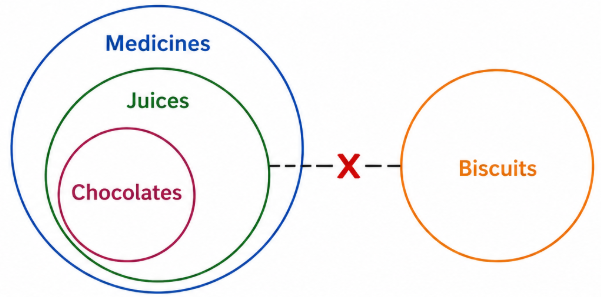
All chocolates are juices.
All juices are medicines.
No juice is a biscuit.
Conclusions:
(I): No medicine is a biscuit.
(II): No chocolate is a biscuit.

  • A.

    Both conclusions (I) and (II) follow.

  • B.

    Only conclusion (I) follows.

  • C.

    Neither conclusion (I) nor (II) follows.

  • D.

    Only conclusion (II) follows.

    ✓ Correct

Answer & Solution

Correct option is D

Given:
​Statements:
All chocolates are juices.
All juices are medicines.
No juice is a biscuit.
Conclusion ​
(I) No medicine is a biscuit → Does not follow, because only juices are stated to be non-biscuits.
(II) No chocolate is a biscuit → Follows, because all chocolates are juices and no juice is a biscuit.
So, Only conclusion (II) follows.
Final Correct Option: (D)
Q2.

Read the given statements and conclusions carefully. You have to take the given statements to be true even if they seem to be at variance from commonly known facts. You have to decide which conclusion(s) logically follow(s) from the given statements.
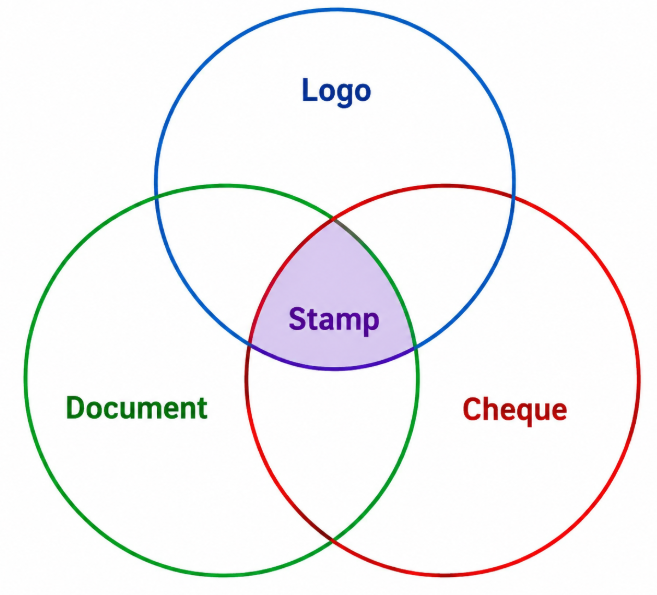
Statements: All stamp are logo. All stamp are cheque. All stamp are document.
Conclusions (I): All logo are document.
Conclusions (II): Some document are cheque.

  • A.

    Both conclusions (I) and (II) follow

  • B.

    Neither conclusion (I) nor (II) follows

  • C.

    Only conclusion (I) follows

  • D.

    Only conclusion (II) follows

    ✓ Correct

Answer & Solution

Correct option is D

Given:
​Statements:
All stamp are logo.
All stamp are cheque.
All stamp are document.​
Conclusion (I): All logo are document. 
This does not follow. We only know that all stamps are logos and documents, but nothing is said about the remaining logos. Therefore, we cannot conclude that all logos are documents.
Conclusion (II): Some document are cheque. 
Since all stamps are both documents and cheques, the stamps form a common group. Hence, some documents are cheques.
Final Answer: (D) Only conclusion (II) follows
Q3.
Read the given statements and conclusions carefully. Assuming that the inform a on given in the statements is true, even if it appears to be at variance with commonly known facts, decide which of the given conclusion(s) logically follow(s) from the statements.
Statements:
1. All hens are juices.
2. Some juices are nests.
3. All pins are nests.
Conclusions:
(I): Some pins are hens.
(II): Some pins are juices​​
  • A.

    Neither conclusion (I) nor (II) follows.

    ✓ Correct
  • B.

    Only conclusion (II) follows.

  • C.

    Only conclusion (I) follows.

  • D.

    Both conclusions (I) and (II) follows.

Answer & Solution

Correct option is A

Statements:
1. All hens are juices.
2. Some juices are nests.
3. All pins are nests.
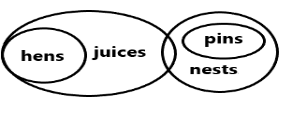
From the given information possible Venn diagram is as follows.
​Conclusions:
I. Some pins are hens. (False, there is no direct connection between pins and hens).
II. Some pins are juices. (False, the overlap between juices and nests does not guarantee a relationship between pins and juices).
Neither conclusion (I) nor (II) follows.
Thus, correct option is (a).
Q4.
Read the given statements and conclusions carefully. Assuming that the information given in the statements is true, even if it appears to be at variance with commonly known facts, decide which of the given conclusion(s) logically follow(s) from the statements.
Statements:
(I) All waters are liquids.
(II) All liquids are juices.
(III) All juices are fruits.
Conclusions:
(I) All waters are fruits.
(II) Some fruits are liquids.​​
  • A.

    Both conclusions (I) and (II) follow.

    ✓ Correct
  • B.

    Only conclusion (I) follows

  • C.

    Only conclusion (II) follows.

  • D.

    Neither conclusion (I) nor (II) follows.

Answer & Solution

Correct option is A

Given,
Statements:
All waters are liquids.
All liquids are juices.
All juices are fruits.

Conclusions:
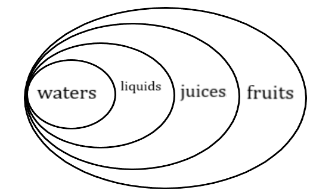
(I) All waters are fruits → Follow (Because, water is a liquid, and all liquids are juices, and all juices are fruits, this means water must also be a fruit).
(II) Some fruits are liquids → Follow (Because, all liquids are juices and all juices are fruits, this means some part of fruits includes liquids).
So, both conclusions (I) and (II) logically follow.
Thus, the correct option is: (a)
Q5.
Read the given statements and conclusions carefully. Assuming that the informa on given in the statements is true, even if it appears to be at variance with commonly known facts, decide which of the given conclusion(s) logically follow(s) from the statements.
Statements:
I. All plums are lamps.
II. Some lamps are ants.
III. All ants are meats.
Conclusions:
(I): All meats are lamps.
(II): Some meats are plums.​​
  • A.

    Only conclusion (II) follows.

  • B.

    Only conclusion (I) follows.

  • C.

    Neither conclusion (I) nor (II) follows.

    ✓ Correct
  • D.

    Both conclusions (I) and (II) follow

Answer & Solution

Correct option is C

Statements:
I. All plums are lamps.
II. Some lamps are ants.
III. All ants are meats.
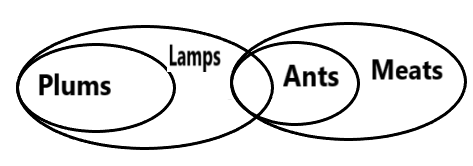
From the given statements possible Venn diagram will be;
Conclusions:
(I): All meats are lamps. (False, Since only some lamps are ants, we cannot conclude that all meats are lamps)​
(II): Some meats are plums. ( False,  However, there is no direct or indirect connection that suggests plums (which are only in lamps) are related to meats)
Neither Conclusion I nor II follows.
Thus, correct option is (c).
Q6.
Read the given statements and conclusions carefully. Assuming that the information given in the statements is true, even if it appears to be at variance with commonly known facts, decide which of the given conclusion(s) logically follow(s) from the statements.
Statements:
I. All ovals are bins.
II. No bin is a car.
III. No bin is a plum.
Conclusions:
(I) No oval is a car.
(II) Some plums are cars.
  • A.

    Neither conclusion (I) nor (II) follows.

  • B.

    Both conclusions (I) and (II) follow.

  • C.

    Only conclusion (II) follows

  • D.

    Only conclusion (I) follows.

    ✓ Correct

Answer & Solution

Correct option is D

Statements:
I. All ovals are bins.
II. No bin is a car.
III. No bin is a plum.
According to the given statements, the possible Venn diagram is as follows:
Let's analyze the conclusions:
Conclusion (I): No oval is a car. (True) - From the Venn diagram, it is evident that all ovals are bins and no bin is a car. o, from this, it can be concluded that no oval is a car. Thus, this conclusion follows.
Conclusion (II): Some plums are cars.  (False) - From the Venn diagram, it is evident that there is no direct relation between plums and cars. So, no definite relation can be drawn. Thus, this conclusion does not follow.
So, only conclusion (I) follows.
Thus, the correct answer is (d).
Q7.

In this question, two statements are given followed by two conclusions. Choose the conclusion(s) which best fit(s) logically.
Statements:
1) Some glasses are spoons.
2) All spoons are jugs.
Conclusions:
I. All jugs are glasses.

II. Some spoons are jugs.

  • A.Only conclusion I follows
  • B.Neither conclusion I nor II follows
  • C.Only conclusion II follows
    ✓ Correct
  • D.

    Both conclusions I and II follow

Answer & Solution

Correct option is C

Statements:
1) Some glasses are spoons.
2) All spoons are jugs.
From the given statements Venn diagram will be: 
Conclusion I: All jugs are glasses → False (This can be possible but not definite)
Conclusion II: Some spoons are jugs → True (This is definitely true as some spoons are jug)
Hence, "only conclusion II" follows. ​​​
Thus, correct option is (b).
Q8.

In this question, two statements are given followed by two conclusions. Choose the conclusion(s) which best fit(s) logically.
Statements:
1) All grass are trees.
2) All flowers are grasses.
Conclusions:
I. All trees are grasses.
II. Some flowers are grasses.

  • A.

    Either conclusion I or II follows

  • B.

    Only conclusion II follows

    ✓ Correct
  • C.

    Both conclusions I and II follow

  • D.

    Only conclusion I follows

Answer & Solution

Correct option is B

Statements:
1) All grass are trees.
2) All flowers are grasses.
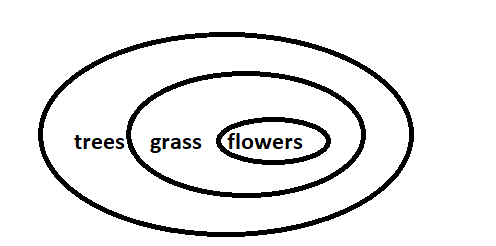
 From the given statements Venn diagram will be: 
I. All trees are grasses. (False, all parts of trees are not in grass)
II. Some flowers are grasses. (True, as all flowers are grass then some will be also)
So, Only option II follows.
Thus, correct option is (b).
Q9.

In this question, two statements are given followed by two conclusions. Choose the
conclusion(s) which best fit(s) logically.
Statements:
1) Some cups are books.
2) Some books are shirts.
Conclusions:
I. Some cups are shirts.
II. All shirts are books.

  • A.

    Only conclusion II follows

  • B.

    Only conclusion I follows

  • C.

    Neither conclusion I nor II follows

    ✓ Correct
  • D.

    Both conclusions I and II follow

Answer & Solution

Correct option is C

Statements:
1) Some cups are books.
2) Some books are shirts.
From the given statements Venn diagram will be: 

Conclusions:
I. Some cups are shirts. (Not follow, because there is no any direct realtion is given between cup and shirt.)
II. All shirts are books. (Not follow, because there is Some books are shirts.)
Therefore, neither conclusion I nor II follows.    

Thus, correct option is (c).

Q10.
In this question, two statements are given followed by two conclusions. Choose the conclusion(s) which best fit(s) logically.
Statements:
1) 'P' is the brother of 'Q'.
2) 'R' is the brother of 'P'.
Conclusions:
I. 'Q' is a girl.
II. 'Q' is a boy.
  • A.Either conclusion I or II follows
    ✓ Correct
  • B.Only conclusion II follows
  • C.Only conclusion I follows
  • D.Both conclusions I and II follow

Answer & Solution

Correct option is A


As per the statement -

From the above either conclusion I or II follows.
Q11.
In this question, two statements are given followed by two conclusions. Choose the conclusion(s) which best fit(s) logically.
Statements:
1) All colours are pants.
2) All pants are brushes.
Conclusions:
I. Some brushes are pants.
II. Some brushes are colours.
  • A.Both conclusions I and II follow
    ✓ Correct
  • B.Only conclusion I follows
  • C.Neither conclusion I nor II follows
  • D.Only conclusion II follows

Answer & Solution

Correct option is A

From the above, both statements are as follows.

Q12.
In this question, two statements are given followed by two conclusions. Choose the conclusion(s) which best fit(s) logically.
Statements:
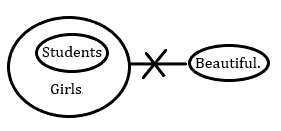
1) All students are girls.
2) No girl is beautiful.
Conclusions:
I. Some students are beautiful.
II. No student is beautiful.
  • A.Only conclusion I follows
  • B.Neither conclusion I nor II follows
  • C.Both conclusions I and II follow
  • D.

    Only conclusion II follows

    ✓ Correct

Answer & Solution

Correct option is D

Given:
All students are girls.
No girl is beautiful.
Conclusion I: Some students are beautiful. (False, no definite relation is given between them so we cannot say anything about their relation)
Conclusion II: No student is beautiful. (True, the relation is given between them so we can consider there is no relation.)
So, Only conclusion II follows. ​​
Q13.
In this question, two statements are given followed by two conclusions. Choose the conclusion(s) which best fit(s) logically.
Statements:
1) All buildings are chalks.
2) All boards are chalks.
Conclusions:
I. Some buildings are boards.
II. Some chalks are boards.
  • A.Both conclusions I and II follow
  • B.Only conclusion I follows
  • C.Only conclusion II follows
    ✓ Correct
  • D.Neither conclusion I nor II follows

Answer & Solution

Correct option is C

I. Some buildings are boards.(False, no area is common between them)
II. Some chalks are boards.(Trie. Some part of area of chalks cover by boards also )
So, Only conclusion II follows.

Q14.

In this question, two statements are given followed by two conclusions. Choose the conclusion(s) which best fit(s) logically.
Statements:
1) All bats are balls.
2) All balls are gloves.
Conclusions:
I. Some gloves are bats.
II. All bats are gloves.

  • A.

    Only conclusion I follows

  • B.

    Either conclusion I or II follows

  • C.

    Only conclusion II follows

  • D.

    Both conclusions I and II follow

    ✓ Correct

Answer & Solution

Correct option is D

​Statements:
1) All bats are balls.
2) All balls are gloves.
 From the given statements Venn diagram will be: 

I. Some gloves are bats. (True, some part is common between them)
II. All bats are gloves.(True. All part of bats are in gloves)
So, Both conclusions I and II follow. 
Thus, correct option is (d).
Q15.
In this question, two statements are given followed by two conclusions. Choose the
conclusion(s) which best fit(s) logically.
Statements:
1)All fish are birds.
2) Some hens are fish.
Conclusion:
I. Some hens are birds.
II. No bird is hen.
  • A.Only conclusion II follows
  • B.Only conclusion I follows
    ✓ Correct
  • C.Either conclusion I or II follows
  • D.Both conclusions I and II follow

Answer & Solution

Correct option is B

Conclusion I: Some hens are birds → True (This is definitely true)
Conclusion II: No bird is hen→ False (This is definitely false)
Hence, "only conclusion I" follows.