RRB JE Aptitude Questions with Detailed Solutions

Get RRB JE Aptitude Questions to prepare for your upcoming exam. Solve the most expected questions and detailed solutions that can be asked in the exam.

Important RRB JE Aptitude Questions

Q1.

The difference between compound interest, compounded annually, and simple interest for 3 years at a rate of 20% per annum is ₹256. What is the principal lent?

  • A.

    ₹1,000

  • B.

    ₹2,000

    ✓ Correct
  • C.

    ₹3,000

  • D.

    ₹4,000

Answer & Solution

Correct option is B

Given:
Time period T = 3 years.
Rate of interest R = 20% per annum.
Difference between CI and SI = ₹256.
Formula Used:
For 3 years, the difference between compound interest and simple interest is:
​D=P×(R100)2×(3+R100)D = P × (\frac{R}{100})^{2} × (3 + \frac{R}{100})​​
where P is principal, R is rate, and D is difference.
Solution:
Substitute the given values D = 256 and R = 20 into the formula:
​256=P×(20100)2×(3+20100)256 = P × (\frac{20}{100})^{2} × (3 + \frac{20}{100})​​

​256=P×(15)2×(3+15)256 = P × (\frac{1}{5})^{2} × (3 + \frac{1}{5})​​

​256=P×125×165256 = P × \frac{1}{25} × \frac{16}{5}​​

​256=P×16125256 = P × \frac{16}{125}​​

​P=256×12516P = \frac{256 × 125}{16}​​

P = 16 × 125 = 2000.
Therefore, the principal lent is ₹2,000.
Final Answer
So the correct answer is (b)
Q2.

P and Q together can fill a cistern with water in 24 hours. If P alone can fill the cistern with water in 72 hours, then in how many hours will Q alone fill three-fourth of the same cistern with water?

  • A.

    54

  • B.

    28

  • C.

    27

    ✓ Correct
  • D.

    55

Answer & Solution

Correct option is C

Given:
Time taken by P and Q together to fill cistern = 24 hours.
Time taken by P alone to fill cistern = 72 hours.
Fraction of cistern to be filled by Q alone = 34.\frac{3}{4}.​​
Formula Used:
If total work is completed in T hours, work done in 1 hour is  1T.\frac{1}{T}.​​
Solution:
Part of cistern filled by P and Q in 1 hour = 124. \frac{1}{24}.​​

Part of cistern filled by P alone in 1 hour = 172. \frac{1}{72}.​

Part of cistern filled by Q alone in 1 hour = 124−172\frac{1}{24} - \frac{1}{72}​​

​1Q=3−172=272=136\frac{1}{Q} = \frac{3 - 1}{72} = \frac{2}{72} = \frac{1}{36}​​
Thus, Q alone can fill the complete cistern in 36 hours.
Time taken by Q alone to fill 34\frac{3}{4}​ of the cistern:
Time = 34\frac{3}{4} ​× 36 = 3 × 9 = 27
Therefore, Q alone takes 27 hours.
Final Answer
So the correct answer is (c)

Q3.

The harmonic mean of 4, 8 and 16 is (Rounded off to four decimal places)

  • A.

    6.5871

  • B.

    6.5817

  • C.

    6.8517

  • D.

    6.8571

    ✓ Correct

Answer & Solution

Correct option is D

Given:
The numbers are 4, 8, and 16.
Formula Used:
Harmonic Mean of n observations x1,x2,...,xnx_{1}, x_{2}, ..., x_{n}​ is given by:
HM = n1x1+1x2+...+1xn \frac{n}{\frac{1}{x_{1}} + \frac{1}{x_{2}} + ... + \frac{1}{x_{n}}}​​
Solution:
Here n = 3.
Calculating the sum of reciprocals:
​14+18+116=4+2+116=716\frac{1}{4} + \frac{1}{8} + \frac{1}{16} = \frac{4 + 2 + 1}{16} = \frac{7}{16}​​
Substituting into the harmonic mean formula:
HM = 3716\frac{3}{\frac{7}{16}}​​

HM = 3×167=487\frac{3 × 16}{7} = \frac{48}{7}​​

HM = 6.857142...
Rounding off to four decimal places gives 6.8571.
Final Answer
So the correct answer is (d)

Q4.

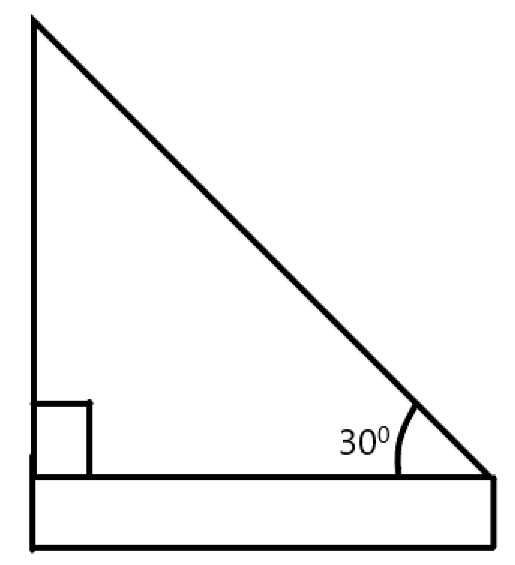
A man, 1.8 m tall, is standing on a 1.0 m high platform near its edge, to observe the top of a building. The building is at distance of 253\sqrt3​ m away from the platform. The angle of elevation from his eye to the top of the building is 30∘.The height (in m ) of the building is:

  • A.

    25.8

  • B.

    27.8

    ✓ Correct
  • C.

    26.8

  • D.

    28.8

Answer & Solution

Correct option is B

Given:
Height of observer = 1.8 m.
Height of platform = 1.0 m.
Distance from platform to building = 25325\sqrt{3}​ m 
Angle of elevation = 30∘30^{\circ}​ 
Formula Used:
In a right-angled triangle:
​tan⁡(θ)=pb\tan(θ) = \frac{p}{b}​​
where p is the perpendicular (opposite side) and b is the base (adjacent side).
Total height of building H = h+eye level height.h + \text{eye level height}.​​
Solution:

Total height of the observer's eye level above the ground = 1.0 + 1.8 = 2.8 m.
Let the height of the building above the observer's eye level be h m.
The horizontal base distance b =253 25\sqrt{3}​ m.
Using the tangent ratio for the angle of elevation θ=30∘:θ = 30^{\circ}:​​
​tan⁡(30∘)=h253\tan(30^{\circ}) = \frac{h}{25\sqrt{3}}​​
Since tan⁡(30∘)=13:\tan(30^{\circ}) = \frac{1}{\sqrt{3}}:​​
​13=h253\frac{1}{\sqrt{3}} = \frac{h}{25\sqrt{3}}​​
h = 25 m.
Total height of the building H = 25 + 2.8 = 27.8 m.
Final Answer
So the correct answer is (b)

Q5.

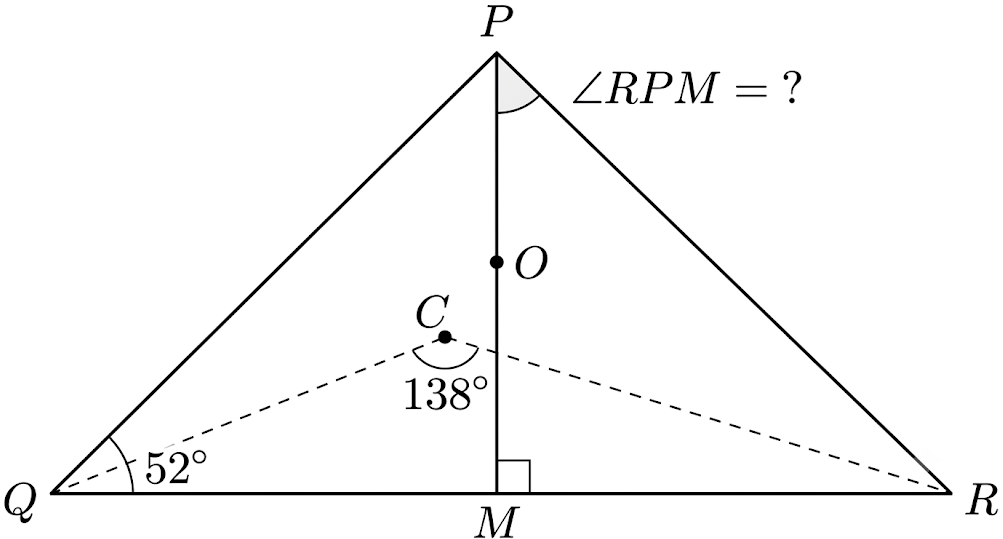
O and C are respectively the orthocenter and the circumcenter of an acute angled triangle ∆PQR. ∠QCR = 138°. A perpendicular PM is dropped from P on side QR. If ∠PQR = 52°, what is the degree measure of ∠RPM?

  • A.

    38

  • B.

    42

  • C.

    69

  • D.

    31

    ✓ Correct

Answer & Solution

Correct option is D

Given:
∆PQR is an acute-angled triangle.
O is the orthocenter and C is the circumcenter.
​∠QCR=138∘.∠QCR = 138^{\circ}.​​
PM is perpendicular to QR.
​∠PQR=52∘.∠PQR = 52^{\circ}.​​
Formula Used:
Angle subtended by an arc at the circumcenter is double the angle subtended at any point on the remaining circumference:
∠QCR = 2∠QPR
In a right-angled triangle, sum of acute angles is 90∘.90^{\circ}.​​
Solution:

Using the circumcenter property at vertex P:
​∠QPR=138∘2=69∘∠QPR = \frac{138^{\circ}}{2} = 69^{\circ}​​
In right-angled triangle PMQ, since PM ⊥ QR, ∠PMQ = 90∘.90^{\circ}.​​
Thus, the sum of ∠PQM and ∠QPM is 90∘: 90^{\circ}:​​
​∠QPM=90∘−52∘=38∘∠QPM = 90^{\circ} - 52^{\circ} = 38^{\circ}​​
From the figure, PM divides vertex angle QPR such that:
∠QPR = ∠QPM + ∠RPM
​69∘=38∘+∠RPM69^{\circ} = 38^{\circ} + ∠RPM​​
∠RPM = 69∘−38∘=31∘. 69^{\circ} - 38^{\circ} = 31^{\circ}.​​
Therefore, the measure of ∠RPM is 31∘.31^{\circ}.​​
Final Answer
So the correct answer is (d)

Q6.

The length of a rectangular field is 34 m more than its breadth. Its area is 5040 m2. Its breadth (in m) is:

  • A.

    37

  • B.

    56

    ✓ Correct
  • C.

    44

  • D.

    54

Answer & Solution

Correct option is B

Given:
Length is 34 m more than breadth.
Area of rectangular field = 5040 m2.m^{2}.​​
Formula Used:
Area of rectangle = l × b
where l is length and b is breadth.
Solution:
Let breadth be b m.
Length l = b + 34 m.
According to the area formula:
b × (b + 34) = 5040
b2b^{2}​ + 34b - 5040 = 0
By testing the given options for breadth b:
If b = 56:
56 × (56 + 34) = 56 × 90 = 5040.
This satisfies the area condition exactly.
Therefore, the breadth of the field is 56 m.
Final Answer
So the correct answer is (b)

Q7.

X people were given a contract for doing a piece of work in 18 days. 2 people did not turn up to work due to sickness, and the rest of the people completed the work in 27 days. What is the value of X?

  • A.

    6

    ✓ Correct
  • B.

    14

  • C.

    10

  • D.

    2

Answer & Solution

Correct option is A

Given:
Initial number of people = X.
Contract duration = 18 days.
Number of sick people who did not work = 2.
Actual days taken by remaining people = 27 days.
Formula Used:
Total work = M1×D1=M2×D2M_{1} × D_{1} = M_{2} × D_{2}​​
where M represents men and D represents days.
Solution:
Total work planned = X × 18 man-days.
Actual workers present = X - 2.
Total work done = (X - 2) × 27 man-days.
Equating the total work:
18 × X = 27 × (X - 2)
2 × X = 3 × (X - 2)
2X = 3X - 6
3X - 2X = 6
X = 6.
Therefore, the initial number of people X was 6.
Final Answer
So the correct answer is (a)

Q8.

A and B jointly start a business. The investment of A is equal to three times the investment of B. Find the share of A in the annual profit of ₹55204.

  • A.

    ₹41,403

    ✓ Correct
  • B.

    ₹40,403

  • C.

    ₹43,403

  • D.

    ₹42,403

Answer & Solution

Correct option is A

Given:
Investment of A = 3 × Investment of B.
Total annual profit = ₹55,204.
Formula Used:
Ratio of profit shares equals ratio of investments.
Solution:
Let investment of B be 1 unit.
Investment of A = 3 units.
Ratio of profit shares A : B = 3 : 1.
Sum of ratio parts = 3 + 1 = 4.
Calculating share of A:
Share of A = 34\frac{3}{4}​ × 55204
Share of A = 3 × 13801 = 41403
Therefore, the share of A is ₹41,403
Final Answer
So the correct answer is (a)

Q9.

A total profit of ₹14,500 is to be distributed amongst A, B, and C such that A : B = 16 : 3 and B : C = 6 : 20. The share (in ₹) of C in the profit is:

  • A.

    5,100

  • B.

    5,000

    ✓ Correct
  • C.

    4,950

  • D.

    4,850

Answer & Solution

Correct option is B

Given:
Total profit = ₹14,500.
Ratio of share A to B = 16 : 3.
Ratio of share B to C = 6 : 20.
Formula Used:
If the combined ratio of shares is A : B : C, then:
Share of C = CA+B+C×P\frac{C}{A + B + C} × P​​
where P is the total profit.
Solution:
First, equate the common ratio term B in both ratios.
We have A : B = 16 : 3 = 32 : 6
And B : C = 6 : 20
Thus, the combined ratio is:
A : B : C = 32 : 6 : 20
Simplifying by dividing by 2:
A : B : C = 16 : 3 : 10
Sum of the ratio parts = 16 + 3 + 10 = 29
Calculating the share of C:
Share of C = 1029×14500 \frac{10}{29} × 14500  = 10 × 500 = 5000

Therefore, the share of C is ₹5,000.
Final Answer
So the correct answer is (b)

Q10.

The following data represents the number of goals scored by a football team in 10 matches.
2, 3, 1, 4, 2, 5, 2, 3, 2, 4
The mode of the above data is x. If one more match is played, and the team scores 3 goals, what will be the difference between the previous mode and the new mode?

  • A.

    1

  • B.

    3

  • C.

    2

  • D.

    0

    ✓ Correct

Answer & Solution

Correct option is D

Given:
Initial goals data in 10 matches: 2, 3, 1, 4, 2, 5, 2, 3, 2, 4.
Goals scored in the 11th match = 3.
Formula Used:
Mode is the value that appears most frequently in a data set.
Solution:
Frequencies in the initial 10 matches:
Goal 1: 1 time
Goal 2: 4 times
Goal 3: 2 times
Goal 4: 2 times
Goal 5: 1 time
The highest frequency is 4, which corresponds to goal 2.
Previous mode = 2.
After the 11th match, one more goal of 3 is added.
Updated frequencies:
Goal 2: 4 times
Goal 3: 2 + 1 = 3 times
The maximum frequency remains 4 (for goal 2).
New mode = 2.
Calculating the difference between previous mode and new mode:
Difference = 2 - 2 = 0.
Final Answer
So the correct answer is (d)

Q11.

David has borrowed an amount of ₹440000 from a bank to start a business. How much simple interest (in ₹) will he pay at a rate of 6% per annum after 2 years?

  • A.

    52800

    ✓ Correct
  • B.

    54800

  • C.

    53800

  • D.

    51800

Answer & Solution

Correct option is A

Given:
Principal borrowed P = ₹4,40,000.
Rate of interest R = 6% per annum.
Time period T = 2 years.
Formula Used:
Simple Interest I = P×R×T100\frac{P × R × T}{100}​​
Solution:
Substitute the given values into the simple interest formula:
​I=440000×6×2100I = \frac{440000 × 6 × 2}{100}​​
I = 4400 × 12 = 52800.
Therefore, the simple interest paid is ₹52,800.
Final Answer
So the correct answer is (a)

Q12.

A solid sphere is melted and recast into 18 identical cones, each having a base radius of 3 cm and height of 18 cm.
Find the radius of the sphere.

  • A.

    9 cm

    ✓ Correct
  • B.

    10 cm

  • C.

    7 cm

  • D.

    8 cm

Answer & Solution

Correct option is A

Given:
Number of identical cones formed = 18.
Base radius of each cone r = 3 cm.
Height of each cone h = 18 cm.
Formula Used:
Volume of sphere Vs=43πR3V_{s} = \frac{4}{3}πR^{3}​​
Volume of cone Vc=13πr2hV_{c} = \frac{1}{3}πr^{2}h​​
where R is radius of sphere, r is radius of cone, and h is height of cone.
Solution:
Since the sphere is melted and recast into 18 cones, the volumes are equal:
​43πR3=18×13πr2h\frac{4}{3}πR^{3} = 18 × \frac{1}{3}πr^{2}h​​

​4R3=18×r2×h4R^{3} = 18 × r^{2} × h​​
Substitute r = 3 and h = 18:
​4R3=18×32×184R^{3} = 18 × 3^{2} × 18​​
​4R3=18×9×18=29164R^{3} = 18 × 9 × 18 = 2916​​
​R3=29164=729R^{3} = \frac{2916}{4} = 729​​
R = 7293\sqrt[3]{729}​ = 9.
Therefore, the radius of the sphere is 9 cm.
Final Answer
So the correct answer is (a)

Q13.

Find the volume of a hemisphere, the circumference of whose base is 35.2 cm (rounded off to two places of decimals; use π = 22/7 ).

  • A.

    369.34 cm3 cm^3​​

  • B.

    363.56  cm3cm^3​​

  • C.

    361.25 cm3 cm^3​​

  • D.

    367.96 cm3 cm^3​​

    ✓ Correct

Answer & Solution

Correct option is D

Given:
Circumference of the circular base of the hemisphere = 35.2 cm.
Formula Used:
Circumference of base C = 2πr
Volume of hemisphere V = 23πr3\frac{2}{3}πr^{3}​​
where r is the base radius.
Solution:
Using the base circumference formula to find radius r:
​2×227×r=35.22 × \frac{22}{7} × r = 35.2​​
​447×r=35.2\frac{44}{7} × r = 35.2​​
​r=35.2×744r = \frac{35.2 × 7}{44}​​
r = 0.8 × 7 = 5.6
The radius is r = 5.6 cm.
Now, calculate the volume of the hemisphere:
​V=23×227×(5.6)3V = \frac{2}{3} × \frac{22}{7} × (5.6)^{3}​​

​V=4421×175.616V = \frac{44}{21} × 175.616​

​V=7727.10421=367.9573...V = \frac{7727.104}{21} = 367.9573...​​

Rounding off to two decimal places, Volume = 367.96 cm3.cm^{3}.​​
Final Answer
So the correct answer is (d)

Q14.

Three persons, A, B and C, took part in a 2000 m race. To reach the finish line at the same time, A can give to B a start of 500 m and to C a start of 300 m. How many metres of start can C give to B in a 3400 m race?

  • A.

    800

  • B.

    200

  • C.

    400

    ✓ Correct
  • D.

    600

Answer & Solution

Correct option is C

Given:
Total distance of first race = 2000 m.
Start given by A to B = 500 m.
Start given by A to C = 300 m.
Total distance of second race = 3400 m.
Formula Used:
Ratio of speeds equals ratio of distances covered in the same time.
Solution:
In the first race of 2000 m, when A covers 2000 m:
Distance covered by B = 2000 - 500 = 1500 m.
Distance covered by C = 2000 - 300 = 1700 m.
Since they finish at the same time, the ratio of speeds of B and C is:
​SBSC=15001700=1517\frac{S_{B}}{S_{C}} = \frac{1500}{1700} = \frac{15}{17}​​
In the second race of 3400 m, let C cover the entire distance of 3400 m.
In the same time, the distance covered by B will be:
​DB=3400×1517D_{B} = 3400 × \frac{15}{17}​​
= 200 × 15 = 3000 m.
The start that C can give to B so they finish together = 3400 - 3000 = 400 m.
Final Answer
So the correct answer is (c)

Q15.

A is faster than B. In a 2500 m race, A gives B a start of 200 meters. A runs at 25 m/s. Who wins and by how much if B runs at 23 m/s?

  • A.

    They finish together

    ✓ Correct
  • B.

    A wins by 50 meters

  • C.

    B wins by 100 meters

  • D.

    A wins by 100 meters

Answer & Solution

Correct option is A

Given:
Total race distance = 2500 m.
Start given by A to B = 200 m.
Speed of A = 25 m/s.
Speed of B = 23 m/s.
Formula Used:
Time T = DS \frac{D}{S}​​
where D is distance and S is speed.
Solution:
Distance A has to run to reach the finish line = 2500 m.
Time taken by A to complete the race:
​TA=250025=100T_{A} = \frac{2500}{25} = 100​​
A takes 100 seconds.
Since B receives a start of 200 m, the distance B has to run = 2500 - 200 = 2300 m.
Time taken by B to complete the race:
​TB=230023=100T_{B} = \frac{2300}{23} = 100​​
B also takes 100 seconds.
Since TA=TBT_{A} = T_{B}​ = 100 seconds, both A and B reach the finish line at the exact same time.
Therefore, they finish together.
Final Answer
So the correct answer is (a)