RRB JE Reasoning Questions with Detailed Solutions

Get RRB JE Reasoning Questions to prepare for your upcoming exam. Solve the most expected questions and detailed solutions that can be asked in the exam.

Important RRB JE Reasoning Questions

Q1.

What will come in the place of ‘?’ in the following equation, if ‘+’ and ‘−‘ are interchanged and ‘×’ and ‘÷’ are interchanged?
16 ÷ 2 + 22 × 2 − 8 = ? + 3

  • A.

    28

  • B.

    31

  • C.

    32

    ✓ Correct
  • D.

    34

Answer & Solution

Correct option is C

Given:
16 ÷ 2 + 22 × 2 − 8 = ? + 3
Interchange:
+ ↔ −
× ↔ ÷
So the equation becomes:
16 × 2 − 22 ÷ 2 + 8 = ? − 3
​16 × 2 − 11 + 8 = ? − 3
32 − 11 + 8 = ? − 3
40 − 11 = ? − 3
29 = ? − 3
Therefore:
? = 32
Correct Answer: (C) 32
Q2.

What should come in place of the '?' in the given series, based on the English
alphabetical order?
PJL OIK NHJ MGI ?

  • A.

    LFH

    ✓ Correct
  • B.

    LEH

  • C.

    LFG

  • D.

    LEG

Answer & Solution

Correct option is A

Information Given:
Series: PJL, OIK, NHJ, MGI, ?
Logic: Each letter moves −1 position in the alphabet in every term.
1st letter: P −1 → O −1 → N −1 → M −1 → L
2nd letter: J −1 → I −1 → H −1 → G −1 → F
3rd letter: L −1 → K −1 → J −1 → I −1 → H
Therefore → LFH
Final Answer:
LFH
Final Correct Option:
(A) LFH
Q3.

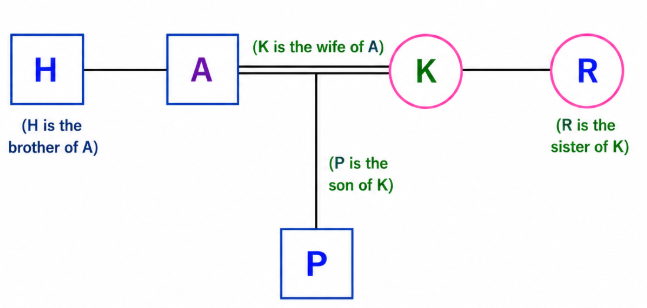
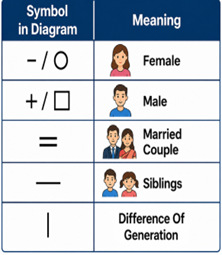
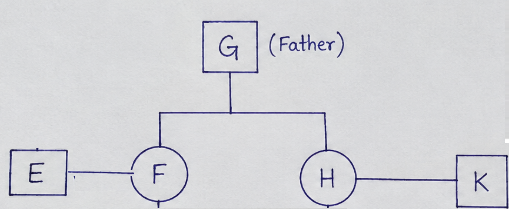
H is the brother of A. R is the sister of K. P is the son of K. K is the wife of A. How is P related to H?

  • A.

    Sister's son

  • B.

    Brother's son

    ✓ Correct
  • C.

    Father's son

  • D.

    Brother

Answer & Solution

Correct option is B

Given:
​H is the brother of A.
R is the sister of K.
P is the son of K.
K is the wife of A.
Therefore, P is H's brother's son.
Correct Answer: (B) Brother's son
Q4.

Seven boxes B, C, D, P, Q, R and S are kept one over the other but not necessarily in the same order. Only three boxes are kept above B. Only one box is kept between P and B. Only three boxes are kept between P and R. R is kept at some place above B. D is kept immediately below R. Q is kept at one of the places above S. C is not kept immediately above or below P. Which box is kept at the lowermost position?

  • A.

    P

  • B.

    S

    ✓ Correct
  • C.

    C

  • D.

    R

Answer & Solution

Correct option is B

Given:
​Seven boxes B, C, D, P, Q, R and S are kept one over the other but not necessarily in the same order.
Only three boxes are kept above B.
Only one box is kept between P and B.
Only three boxes are kept between P and R.
R is kept at some place above B.
D is kept immediately below R.
Q is kept at one of the places above S.
C is not kept immediately above or below P.
Position
Box
1 (Top)
C
2
R
3
D
4
B
5
Q
6
P
7 (Bottom)
S
Therefore, the lowermost box is S.
Correct Answer: (B) S
Q5.

This question is based on the five, three-digit numbers given below.
(Left) 857 329 417 628 751 (Right)
(Example- 697 – First digit = 6, second digit = 9 and third digit = 7)
What will be the resultant if third digit of the highest number is added to the third digit of lowest number?

  • A.

    14

  • B.

    17

  • C.

    16

    ✓ Correct
  • D.

    15

Answer & Solution

Correct option is C

Given numbers:
(Left) 857 329 417 628 751 (Right)
Find the highest and lowest numbers
Highest number = 857
Lowest number = 329
Identify their third digits
857 → third digit = 7
329 → third digit = 9
Add them: 7 + 9 = 16
Correct Answer: (C) 16
Q6.

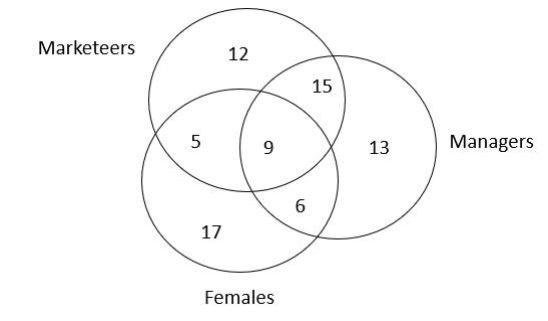
Study the given diagram carefully and answer the question that follows. The numbers in different sections indicate the number of persons. (NOTE: You have to take the given data to be true even if they seem to be at variance from commonly known facts.)

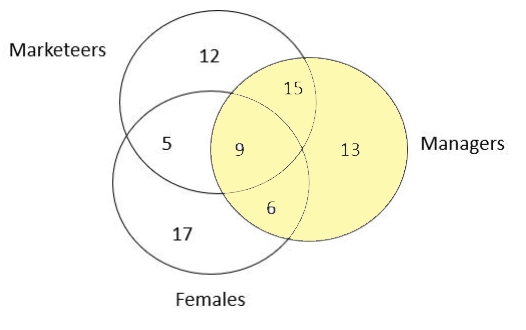
How many managers are there?

  • A.

    44

  • B.

    42

  • C.

    43

    ✓ Correct
  • D.

    41

Answer & Solution

Correct option is C

So, there are managers: (13 + 15 + 9 + 6) = 43
Thus, the correct option is: (c)​​
Q7.

In a certain code language,
A + B means ‘A is the daughter of B’
A – B means ‘A is the brother of B’
A × B means ‘A is the wife of B’
A ÷ B means ‘A is the father of B’
Based on the above, how is E related to K if ‘E – F + G ÷ H × K’?

  • A.

    Wife's brother

    ✓ Correct
  • B.

    Wife's father

  • C.

    Brother

  • D.

    Father

Answer & Solution

Correct option is A

Given:
​A + B means ‘A is the daughter of B’
A – B means ‘A is the brother of B’
Sign
+
–
×
÷
Relations
Daughter
Brother
Wife
Father
‘E – F + G ÷ H × K’?
Therefore, E is K's wife's brother.
Final Answer:
Wife's brother
Final Correct Option:
(A) Wife's brother
Q8.

C, H, A, N, G and E, each have a different age. C’s age is 21 years, and C is younger than H and older than A. Four people have ages less than 21 years. Only one person is younger than N. G is not the youngest. G is younger than A. Who is the youngest?

  • A.

    N

  • B.

    G

  • C.

    E

    ✓ Correct
  • D.

    A

Answer & Solution

Correct option is C

Given:
​C, H, A, N, G and E, each have a different age.
C’s age is 21 years, and C is younger than H and older than A.
Four people have ages less than 21 years.
Only one person is younger than N.
G is not the youngest. G is younger than A.

Let's arrange the ages carefully.
C = 21 years
C is younger than H → H > 21
C is older than A → A < 21
Four people are younger than 21 → exactly A, N, G, E are below 21
Only one person is younger than N → N is the 2nd youngest
G is younger than A → G < A
G is not the youngest
Since N is 2nd youngest and G is not youngest, the only person who can be younger than N is E.
Thus:
E < N < G < A < C < H
Therefore, the youngest is E.
Correct Answer: (C) E
Q9.

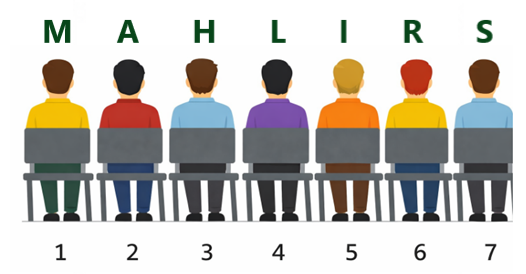
Seven people, A, L, M, I, R, H and S, are sitting in a row, facing north. No one sits to the right of S. Only three people sit between S and H. Only two people sit between H and R. M sits third to the left of L. I sits to the immediate right of L. How many people sit between A and R?

  • A.

    Four

  • B.

    Two

  • C.

    One

  • D.

    Three

    ✓ Correct

Answer & Solution

Correct option is D

Given:
​Seven people, A, L, M, I, R, H and S, are sitting in a row, facing north.
No one sits to the right of S.
Only three people sit between S and H.
Only two people sit between H and R.
M sits third to the left of L.
I sits to the immediate right of L.
So, Three people sit between A and R.
Thus, the correct option is: (d)
Q10.

Based on the alphabetical order, three of the following four are alike in a certain way and thus form a group. Which is the one that does not belong to that group?
(Note: The odd man out is not based on the number of consonants/vowels or their position in the letter cluster.)

  • A.

    GFI

  • B.

    MMO

    ✓ Correct
  • C.

    ZYB

  • D.

    QPS

Answer & Solution

Correct option is B

Logic: Three follow the same alphabetical pattern: −1, +3.
Explanation:
GFI → G−1→ F, F+3 → I ✓
MMO → M+0→ M, M+2 → O ✗
ZYB → Z−1→ Y, Y+3 → B ✓
QPS → Q−1→ P, P+3 → S ✓
Final Answer:
MMO
Final Correct Option:
(B) MMO
Q11.

In a certain code,
'blue pen write' is coded as 'ka tu re'
'red pen draw' is coded as 'mo tu si'
'blue brush draw' is coded as 'ka lo si'
(all the codes are two letter coded only)
What is the code for “blue pen”?

  • A.

    lo si

  • B.

    re ka

  • C.

    mo lo

  • D.

    ka tu

    ✓ Correct

Answer & Solution

Correct option is D

Information Given:
blue pen write → ka tu re
red pen draw → mo tu si
blue brush draw → ka lo si
​Logic: Common word → common code
Let's identify the common words and codes:
blue appears in the 1st and 3rd statements → ka
pen appears in the 1st and 2nd statements → tu
draw appears in the 2nd and 3rd statements → si
Therefore:
blue pen = ka tu
Correct Answer: (D) ka tu
Q12.

A question is followed by two statements numbered (I) and (II). You have to decide whether the data provided in the statements are sufficient to answer the question. Read both the statements carefully and decide the appropriate answer.
Six people, A, B, C, D, E and F, are sitting in a straight line facing north. How many people sit to the right of D?
I: No one sits to the right of F. Only two people sit between F and B.
II: D sits to the immediate left of F. E sits to the immediate left of B.

  • A.

    Data in Statement I alone is sufficient to answer the question while data in statement II is not

  • B.

    Data in Statement II alone is sufficient to answer the question while data in statement I is not

  • C.

    Data in both statements I and II together (and not statement I alone or statement II alone) are sufficient to answer the
    question

    ✓ Correct
  • D.

    Data in both statements I and II together are NOT sufficient to answer the question

Answer & Solution

Correct option is C

Information Given:
6 people: A, B, C, D, E, F; all face north.
Question: Number of people to the right of D.
Let's solve carefully.
Statement I alone:
No one sits to the right of F → F is at the 6th position
Two people sit between F and B → B is at the 3rd position
But D's position is not fixed.
→ Statement I alone is not sufficient.
Statement II alone:
D sits immediately to the left of F
E sits immediately to the left of B
The exact positions of these pairs are not fixed, so D's position cannot be determined.
→ Statement II alone is not sufficient.
Statements I + II together
From Statement I:
F = 6th position
B = 3rd position
From Statement II:
D is immediately left of F → D = 5th position
E is immediately left of B → E = 2nd position
Arrangement:
_ E B _ D F
Therefore, only one person sits to the right of D (F).
Answer: (C) — Data in both statements I and II together, but neither alone, are sufficient.
Q13.

Each of B, Q, C, N, X, U and M has an exam on a different day of a week, starting from Monday and ending on Sunday of the same week. Only two people have exams before Q. Only one person has the exam after N. B has the exam before U but after Q. X has the exam immediately before C. M does not have the exam before U. How many people have exams between U and X?

  • A.

    Two

  • B.

    Three

    ✓ Correct
  • C.

    One

  • D.

    Four

Answer & Solution

Correct option is B

Given:
​Each of B, Q, C, N, X, U and M has an exam on a different day of a week, starting from Monday and ending on Sunday of the same week.
Only two people have exams before Q.
Only one person has the exam after N.
B has the exam before U but after Q.
X has the exam immediately before C.
M does not have the exam before U.
Day
Person
Monday
X
Tuesday
C
Wednesday
Q
Thursday
B
Friday
U
Saturday
N
Sunday
M
So, Three (3) people have exams between U and X.
Thus, teh correct option is: (b)
Q14.

What should come in place of '?' in the given series?
7 10 16 25 ?

  • A.

    34

  • B.

    43

  • C.

    40

  • D.

    37

    ✓ Correct

Answer & Solution

Correct option is D

Information Given:
Series: 7, 10, 16, 25, ?

Logic:
Differences increase by 3: +3, +6, +9, +12.

Explanation:
7 + 3 = 10

→ 10 + 6 = 16

→ 16 + 9 = 25

→ 25 + 12 = 37

Final Answer:
37

Final Correct Option:
D

Q15.

What should come in place of ‘?’ in the given series?
145, 129, 113, 97, 81, ?

  • A.

    64

  • B.

    61

  • C.

    63

  • D.

    65

    ✓ Correct

Answer & Solution

Correct option is D

Information Given:
Series: 145, 129, 113, 97, 81, ?
Logic: Each term decreases by 16.
145 − 16 = 129
129 − 16 = 113
113 − 16 = 97
97 − 16 = 81
81 − 16 = 65
Correct Answer: (D) 65