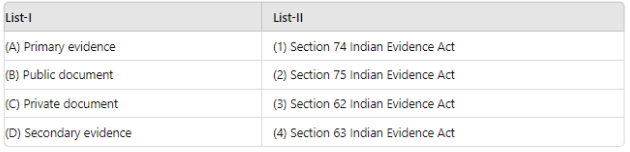
Correct option is D
Section 65 of the Indian Evidence Act, 1872 provides for the admissibility of secondary evidence. This section outlines the conditions under which secondary evidence can be admitted in court when the original document is unavailable. Secondary evidence includes copies of documents, counterparts of documents, oral accounts of the contents of a document, and other forms that can be used when the original is lost, destroyed, or otherwise unobtainable.
Information Booster:
1. Section 65: Specifies the circumstances under which secondary evidence of the contents of documents is admissible.
2. Types of Secondary Evidence: Includes certified copies, copies made from the original, counterparts of documents, and oral accounts.
3. Conditions: Secondary evidence can be used when the original is lost, destroyed, or in possession of the opponent.
4. Legal Relevance: Ensures that justice is not hindered due to the unavailability of primary evidence.
5. Evidence Act: Part of the broader framework that governs the admissibility and use of evidence in legal proceedings.
6. Reliability: Secondary evidence must meet certain standards to be considered reliable and admissible.
Additional Information:
· Section 63 (a): Defines what constitutes secondary evidence but does not deal with its admissibility.
· Section 61 (b): States that the contents of documents may be proved either by primary or secondary evidence, without detailing the conditions for the admissibility of secondary evidence.
· Section 60 (c): Deals with oral evidence and requires that it must be direct, i.e., heard or seen by the witness personally.