
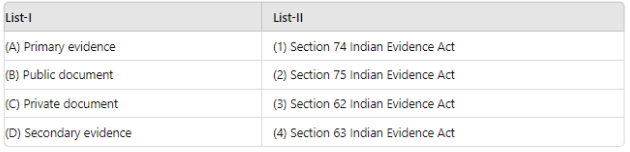
Correct option is A
· Primary evidence is defined under Section 62 of the Indian Evidence Act. It refers to the original document itself, which is produced before the court for inspection.
· Public document is defined under Section 74 of the Indian Evidence Act. These are documents made by a public officer in the discharge of his official duty and include public records kept in any state.
· Private document is covered under Section 75 of the Indian Evidence Act. These are all documents other than public documents.
· Secondary evidence is described under Section 63 of the Indian Evidence Act. It includes certified copies, copies made from the original by mechanical processes, oral accounts of the contents of a document, etc.
Information Booster:
1. Section 62 - Primary Evidence: This section lays down that primary evidence means the document itself produced for the inspection of the court.
2. Section 74 - Public Documents: Public documents include documents forming the acts or records of the acts of sovereign authority, official bodies, tribunals, and public officers.
3. Section 75 - Private Documents: These are documents other than public documents and do not enjoy the presumption of correctness.
4. Section 63 - Secondary Evidence: Secondary evidence includes copies of original documents, oral accounts of the contents of a document, and other types of copies or representations of the original document.
Additional Information:
· Primary Evidence (Section 62): The best evidence that can be produced in court and holds the highest evidentiary value.
· Public Documents (Section 74): Have a presumption of genuineness, which can be challenged only under certain conditions.
· Private Documents (Section 75): Need to be proved by primary or secondary evidence, as they do not have the presumption of correctness like public documents.
· Secondary Evidence (Section 63): Admissible only when the original document is unavailable for reasons acceptable to the court.


