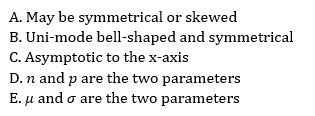
Correct option is B
Normal distribution was discovered by De Moivre in 1733. It is approximate to the binomial distribution. it is also known as a Gaussian distribution in which values are randomly distributed
Properties of Normal distribution.
Symmetry:
· The normal distribution curve is perfectly symmetrical around the mean (μ\muμ).
· This symmetry implies that the mean, median, and mode of the distribution are all equal.
Bell-Shaped Curve:
· The graph of the normal distribution forms a bell-shaped curve.
· It has a single peak at the mean, indicating the most likely value.
Mean, Median, and Mode:
· In a normal distribution, the mean (μ), median, and mode are identical and located at the center of the distribution.
Unimodal:
· The normal distribution has only one peak, making it unimodal.
Asymptotic:
· The tails of the normal distribution extend indefinitely and approach, but never touch, the horizontal axis.
Defined by Two Parameters:
· A normal distribution is fully characterized by its:
·
Mean (μ): Determines the location of the center.
·
Standard Deviation (σ): Determines the spread or width of the distribution.
Empirical Rule (68-95-99.7 Rule):
· Approximately:
· 68% of the data lies within 1 standard deviation (μ±σ).
· 95% of the data lies within 2 standard deviations (μ±2σ).
· 99.7% of the data lies within 3 standard deviations (μ±3σ).
Standard Normal Distribution:
· A normal distribution with a mean of 0 and a standard deviation (σ) of 1.
· Standard normal values are also called
z-scores, representing the number of standard deviations a value is from the mean.
Area Under the Curve:
· The total area under the curve equals 1, representing the entire probability distribution.
Independent of Scale:
· Scaling or shifting a normal distribution does not change its shape. However, it alters the mean and standard deviation.
Hence, only options (B), (C) and (E) are correct.
 English
 10 Questions
 20 Marks
 12 Mins