Correct option is B
The correct answer is (b) Constant marginal utility from successive units.
Explanation
The Cardinal Utility approach, primarily developed by Alfred Marshall, is built on the
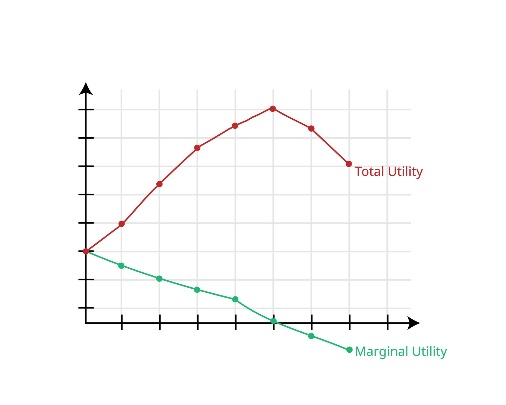
Law of Diminishing Marginal Utility. This law states that as a consumer consumes more units of a commodity, the additional satisfaction (utility) derived from each successive unit
decreases, rather than remaining constant. If marginal utility remained constant, a consumer would never reach saturation.
INFORMATION BOOSTER
·
Rationality assumes the consumer aims to maximize total utility with a limited income.
·
Cardinal Measurement treats utility as a quantifiable entity measured in hypothetical units called "utils."
· The
Constant Marginal Utility of Money ensures that money acts as a stable measuring rod for utility.
· Total Utility increases at a diminishing rate as long as Marginal Utility is positive.
ADDITIONAL KNOWLEDGE
·
(a) Rationality is a core assumption where the consumer is well-informed and acts logically to gain maximum satisfaction.
·
(c) Constant marginal utility of money assumes the "worth" of a dollar stays the same for the consumer regardless of their wealth level.
·
(d) Utility is measurable is the defining trait of the
cardinal approach, unlike the
ordinal approach which only ranks preferences.
 English
 10 Questions
 20 Marks
 12 Mins