arrow
arrow
arrow
​Wheat plants can have kernels of white colour or in shades of red i.e. light red, red, dark red and very dark red (purple). A researcher made the fol
Question

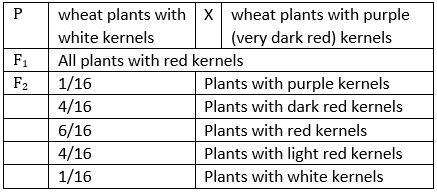
Wheat plants can have kernels of white colour or in shades of red i.e. light red, red, dark red and very dark red (purple). A researcher made the following cross:

The following conclusions are made from the results obtained:
A. It is a dihybrid cross where white colour is coded by gene A and the purple colour is coded by gene B
B. Two genes, both coding for the colour of kernel each having two alleles, one that produced red pigment and the other that produced no pigment
C. Four genes, one coding for no pigment, which is epistatic over the other genes. The remaining three genes have 2 alleles each, one that produced red pigment and the other that produced no pigment
D. The trait is influenced by the environment leading to the observed variation in kernel colour

Which of the following conclusion(s) is/are correct?

A.

A only

B.

B only

C.

C only

D.

C and D only

Correct option is B

Explanation-

Given F₂ Phenotypic Ratio:
Purple         -  1
Dark red     -   4
Red             -   6
Light red     -    4
White          -  1
This is a 1:4:6:4:1 ratio, which is a hallmark of quantitative inheritance (or polygenic inheritance) — specifically, two genes with additive effects:
→ When two genes (say A and B) each have alleles:
                Dominant (A, B): contributes pigment
                Recessive (a, b): does not
Then total number of dominant alleles across two loci (A and B) can produce:
4 (AABB)    -    Purple   -  1
3 (AABb, AaBB)    -  Dark red    - 4
2 (AaBb, AAbb, aaBB)    -  Red    -  6
1 (Aabb, aaBb)     -     Light red   -  4
0 (aabb)    -    White    -  1
→ This exactly matches the 1:4:6:4:1 observed.
Statements:
Statement B : Two genes, both coding for the colour of kernel and each gene having two alleles, one that produced red pigment and the other that produced no pigment.
This is the classic description of additive polygenic inheritance involving two genes → CORRECT.
Incorrect statements -
Statement A  :  It is a dihybrid cross where white colour is coded by gene A and the purple colour is coded by gene B
This implies independent traits, which would give a 9:3:3:1 or other dihybrid ratios, not 1:4:6:4:1.
Statement C :  Four genes, one coding for no pigment, which is epistatic over the other genes. The remaining three genes have 2 alleles each, one that produced red pigment and the other that produced no pigment
Overly complicated; the observed ratio only needs two genes, not four.
Statement D : The trait is influenced by the environment leading to the observed variation in kernel colour
No evidence of environmental influence given — this is a pure Mendelian F2 result.

 Final Answer: Option b – B only
Similar Questions

test-prime-package

Access ‘CSIR NET Life Sciences’ Mock Tests with

  • 60000+ Mocks and Previous Year Papers
  • Unlimited Re-Attempts
  • Personalised Report Card
  • 500% Refund on Final Selection
  • Largest Community
students-icon
353k+ students have already unlocked exclusive benefits with Test Prime!
test-prime-package

Access ‘CSIR NET Life Sciences’ Mock Tests with

  • 60000+ Mocks and Previous Year Papers
  • Unlimited Re-Attempts
  • Personalised Report Card
  • 500% Refund on Final Selection
  • Largest Community
students-icon
353k+ students have already unlocked exclusive benefits with Test Prime!
Our Plans
Monthsup-arrow