






Correct option is B
Ans. (b) Hyperactive deep tendon reflexes
Explanation:
An
Upper Motor Neuron (UMN) lesion affects the neurons in the central nervous system (brain and spinal cord), specifically the corticospinal or pyramidal tract. This results in a characteristic set of signs and symptoms:
1.
Hyperactive Deep Tendon Reflexes (Hyperreflexia) →
(Correct Answer)
· The upper motor neurons normally exert inhibitory control over reflex activity.
· When UMNs are damaged, this inhibitory control is lost, leading to
exaggerated reflexes (hyperreflexia).
· This is a hallmark feature of
UMN lesions seen in conditions like stroke, multiple sclerosis, and spinal cord injuries.
2.
Hypotonia (Reduced Muscle Tone) → (Incorrect Choice)
· Hypotonia is typically a feature of
Lower Motor Neuron (LMN) lesions, not UMN lesions.
· In UMN lesions, initial
spinal shock may cause temporary hypotonia, but over time,
spasticity and hypertonia develop due to loss of inhibitory control.
3.
Flaccid Paralysis → (Incorrect Choice)
· Flaccid paralysis (loss of muscle tone with no resistance) is associated with
LMN lesions, not UMN lesions.
· UMN lesions lead to
spastic paralysis, where muscles are stiff and resistant to movement.
4.
Fasciculations → (Incorrect Choice)
· Fasciculations (visible, involuntary muscle twitches) occur in
LMN lesions due to the spontaneous discharge of degenerating motor neurons.
· UMN lesions do
not cause fasciculations because the lower motor neurons remain intact.
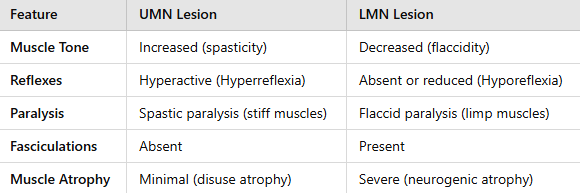
Key Features of UMN Lesions:
 English
 100 Questions
 100 Marks
 90 Mins


