






Correct option is C
Stepwise Interpretation:
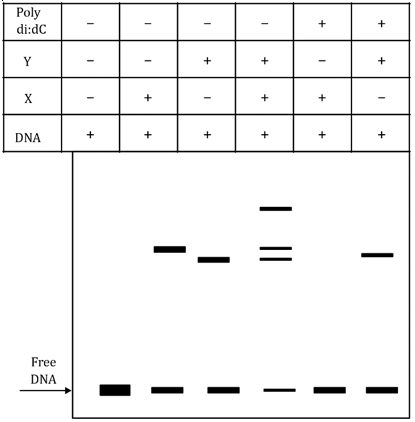
Lane 1 (DNA alone): Shows free DNA at the bottom, indicating no protein bound.
Lane 2 (DNA + X): Shift observed compared to free DNA — indicates X binds DNA.
Lane 3 (DNA + Y): Shift observed, but different from lane 2 — indicates Y binds DNA but differently from X.
Lane 4 (DNA + X + Y): Two distinct shifts are seen, representing X-DNA and Y-DNA complexes, suggesting both proteins bind DNA, but separately.
Lane 5 (DNA + Poly dI:dC): No shift, meaning Poly dI:dC alone doesn't bind DNA.
Lane 6 (DNA + X + Poly dI:dC): Shift reduced or lost compared to lane 2 — Poly dI:dC competes with DNA for X binding, indicating X is not sequence-specific (since Poly dI:dC is a nonspecific competitor).
Lane 7 (DNA + Y + Poly dI:dC): Shift still present despite competitor — indicating Y binds DNA in a sequence-specific manner, unaffected by nonspecific competitor.
Correct interpretation:
X does not bind DNA in a sequence-specific manner (because Poly dI:dC competes and reduces binding).
Y binds DNA in a sequence-specific manner (Poly dI:dC does not interfere).
Final answer:
Option 3: Both proteins bind to DNA but Y binds in a sequence-specific manner.


