Correct option is C
Explanation :
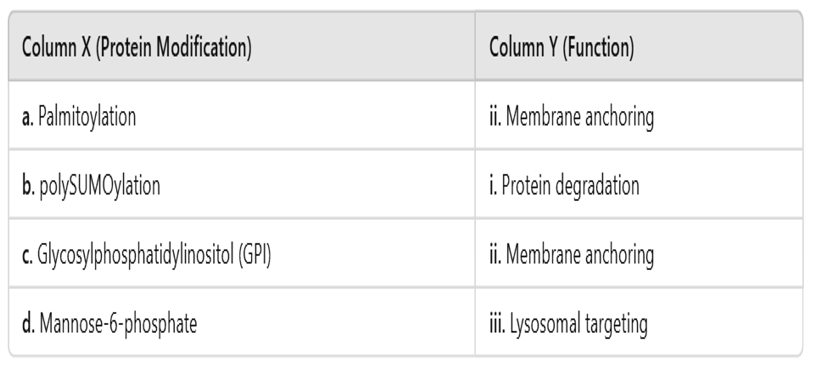
- Palmitoylation → Membrane Anchoring (ii)
- Palmitoylation adds a fatty acid (palmitate) to proteins, making them hydrophobic and anchoring them to the membrane.
- Commonly found in membrane proteins and signaling molecules.
- polySUMOylation → Protein Degradation (i)
- SUMOylation (Small Ubiquitin-like Modifier attachment) regulates protein stability, degradation, and nuclear transport.
- It plays a role similar to ubiquitination, tagging proteins for degradation or cellular localization.
- Glycosylphosphatidylinositol (GPI) Anchor → Membrane Anchoring (ii)
- GPI anchors tether proteins to the outer membrane of the plasma membrane.
- Essential for signaling proteins and lipid raft-associated proteins.
- Mannose-6-phosphate → Lysosomal Targeting (iii)
- Mannose-6-phosphate (M6P) tags proteins for transport to lysosomes.
- Lysosomal hydrolases receive this modification in the Golgi apparatus, allowing recognition by M6P receptors
Information Booster:
- Post-translational modifications (PTMs) regulate protein function, localization, and degradation.
- Palmitoylation and GPI anchoring ensure proteins are membrane-bound.
- SUMOylation is involved in nuclear transport, transcription regulation, and proteasomal degradation.
- Mannose-6-phosphate ensures proteins reach lysosomes, preventing lysosomal storage disorders.
- Defects in lysosomal targeting (e.g., I-cell disease) result in severe metabolic dysfunctions.