






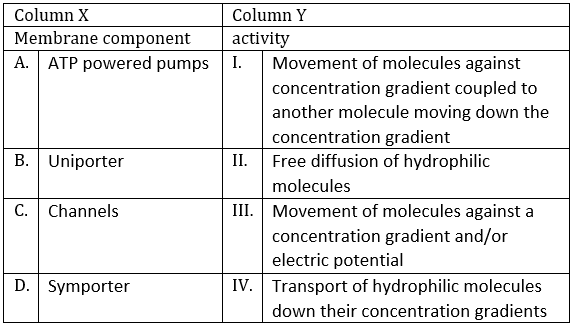
Correct option is D
Match based on the given answer
- A-III: ATP-powered pumps → "Movement of molecules against a concentration gradient and/or electrical potential."
- ATP-powered pumps (like the sodium-potassium pump) perform primary active transport, moving molecules against their gradient using ATP. This matches III, as it involves movement against a concentration gradient (and often an electrical potential for ions).
- B-IV: Uniporter → "Transport of hydrophilic molecules down their concentration gradients."
- Uniporters facilitate the diffusion of a single type of molecule (e.g., glucose via GLUT transporters) down its concentration gradient. This matches IV, as it involves hydrophilic molecules moving down their gradient.
- C-II: Channels → "Free diffusion of hydrophilic molecules."
- Channels (e.g., ion channels) allow hydrophilic molecules like ions to move down their concentration or electrochemical gradient. The term "free diffusion" here is a bit misleading—channels facilitate diffusion, not "free" diffusion (which typically occurs without a protein). However, in the context of the problem, this likely means passive diffusion through a protein, which fits channels. So, II aligns with channels.
- D-I: Symporter → "Movement of molecules against concentration gradient coupled to another molecule moving down the concentration gradient."
- Symporters (e.g., sodium-glucose symporter) move one molecule against its gradient while another moves down its gradient (secondary active transport). This matches I perfectly.


