Correct option is A
Explanation-
Retrotransposons are genetic elements that replicate through an RNA intermediate using reverse transcriptase, and then insert themselves back into the genome. They are divided into two major types:
1. LTR Retrotransposons (Long Terminal Repeats)
Structure: Flanked by long terminal repeats at both ends.
Mechanism: Reverse-transcribed and inserted back into DNA.
Found in: Yeast, plants, Drosophila.
Examples: copia elements, gypsy elements
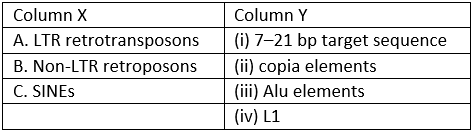
A – (ii) → LTR retrotransposons = copia elements
2. Non-LTR Retroposons
These do not have LTRs. They are further divided into:
a. LINEs (Long Interspersed Nuclear Elements)-
They are Autonomous (they encode reverse transcriptase)
Most studied: L1 (LINE-1) in humans
Insert at specific target sequences, generally 7–21 base pairs in length.
B – (i) → Non-LTR retroposons = 7–21 bp target sequences
b. SINEs (Short Interspersed Nuclear Elements)-
They are Non-autonomous (they borrow reverse transcriptase from LINEs)
They do not code for proteins
Most studied: Alu elements in primates
C – (iii) → SINEs = Alu elements
Final Answer: Option a - A – (ii): LTR → copia
B – (i): Non-LTR → 7–21 bp target
C – (iii): SINEs → Alu