Correct option is C
Given:
The radius of the sphere = radius of the base of the right circular cylinder = r
Total volume =
Formula Used:
Volume of a sphere:
Volume of a cylinder: V
Solution:
h = r







The radius of a sphere, 'r', is equal to the radius of the base of a right circular cylinder. The total volume of these two solids = . If 'h' is the height of the cylinder, find .
Given:
The radius of the sphere = radius of the base of the right circular cylinder = r
Total volume =
Formula Used:
Volume of a sphere:
Volume of a cylinder: V
Solution:
h = r
 English
 100 Questions
 100 Marks
 90 Mins English English100 Questions100 Marks90 Mins English English40 Questions30 Marks25 Mins English
The curved surface area of a solid metallic right circular cylinder is 1792π cm² and its base radius is 32 cm. It is melted and recast into 42 solid spherical balls of equal radius. What is the surface area (in cm²) of a ball ?
The number of bricks, which will be required to make a wall which is 8m long, 6m high and 22.5 cm thick if each brick measures 25 cm ×11.25 cm × 6 cm is
A conical vessel whose internal base radius is 18 cm and height 60 cm is full of a liquid. The contents ofthe vessel are emptied into a cylindrical vessel with base of internal radius 15 cm. The height (in cm) to which the liquid will rise in the cylindrical vessel is:
The diameter of a solid metallic sphere is 3.5 cm. Such 96 spheres are melted and recast into a solid right circular cylinder of height 56 cm.
What is the curved surface area (in cm²) of the cylinder?
A solid hemisphere of radius 10 cm is melted into two cones of equal height. If each cone’s radius is 5 cm, what is the height of each cone?
A hemisphere and a cone share the same base and have equal volumes. Given that their common radius is R, determine the height of the cone.
A cylinder and hemisphere have the same radius. Their combined height is 30 cm. If the cylinder and hemisphere have equal volumes, find the radius.
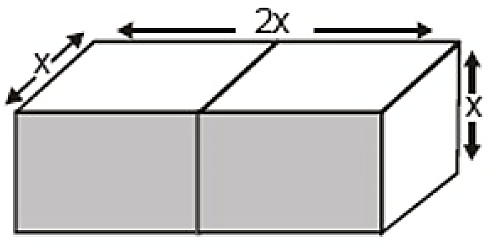
Two cubes each of volume 125 cm³ are joined end to end. The total surface area of the resulting cuboid is:
Find the volume (in cm³) of the largest right circular cone that can be cut out from a cube with an edge of 8 cm.
Use
Five solid cubes, each of volume 1,09,41,048 cm³, are joined end to end to form a cuboid. What is the lateral surface area (in cm²) of the cuboid?


Suggested Test Series

Suggested Test Series
