
Correct option is B
Criterion of feasibility of a transition

Symmetry selection rules for Infrared Spectra
For the fundamental transition in the ith normal mode of vibration,

where Ψ0 is the vibrational ground wave function and Ψ1, is the vibrational first excited wave function. It is known that
(i) The vibrational ground wave function is totally symmetric.
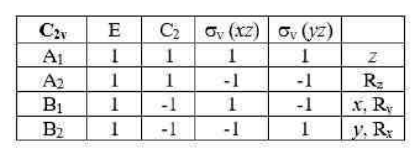
(ii) The symmetry properties of the component of the dipole moment are the same as those of a translational vector along the same axis.
(iii) The symmetric properties of the first excited vibrational wave function are the same as those of irreducible representation of the normal mode of vibration.
In order that the direct product of

belongs to the totally symmetric representation, both

should belong the same representation.
Thus the essential criterion for observing fundamental transition in the infrared spectroscopy is
A fundamental transition will be infrared active if the normal mode which is excited belongs to the same representation as any one or several of the Cartesian coordinates.
Symmetry selection rules for Raman Spectra
The symmetry selection rule for Raman spectra is derived from the integral


A fundamental transition will be Raman active if the normal mode involved belongs to the same irreducible representation as one or more of the components of the polarizability tensor of the molecule.
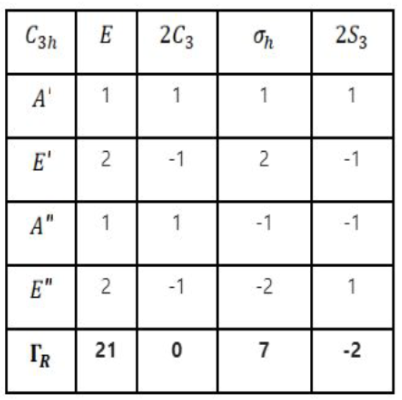
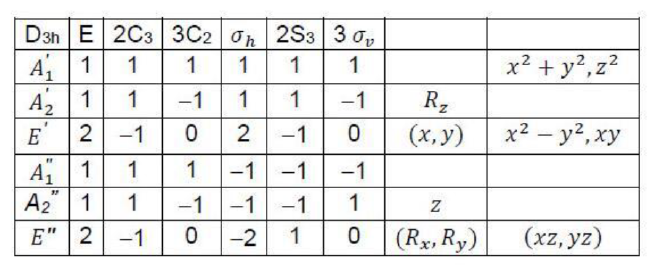
E' and A2" are IR active.
E' and A1'are Raman active.
Both bands at 995 and 244 cm-1 are observed in the IR and Raman spectrum of the BCl3 molecule. As only the E' mode is common between the IR and Raman spectrum of the BCl3 molecule, the frequency of E' mode is 995 and 244 cm-1. Thus, the remaining A1' mode in Raman spectrum has a frequency of 471 cm-1.