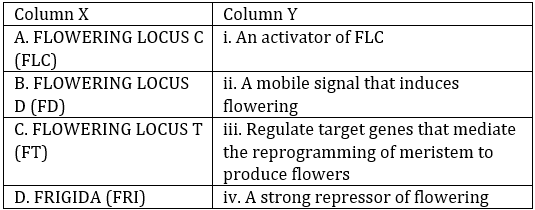
Correct option is C
The correct answer is: (3) Flowering locus T (FT).
Explanation:
Florigen is the mobile signal that regulates flowering in plants. Flowering locus T (FT) is the gene that encodes florigen in plants, and it is expressed in the leaves. FT protein moves from the leaves to the shoot apical meristem (SAM), where it triggers the induction of flowering. FT works in conjunction with other proteins like CONSTANS (CO) to regulate flowering time in response to environmental signals such as light and temperature.
Information Booster:
FT (Flowering locus T) encodes florigen, a protein that travels from the leaves to the shoot apical meristem, initiating the flowering process.
FT interacts with other regulatory proteins such as CONSTANS (CO) and FLOWERING LOCUS C (FLC) to fine-tune flowering based on environmental cues.
FT expression is regulated by CO, which is sensitive to light, ensuring that flowering occurs at the appropriate time of year.
The movement of FT from the leaves to the meristem is crucial for the transition from vegetative to reproductive growth in plants.
Additional Knowledge:
FLC (option 1) is a gene that represses flowering by inhibiting FT expression, particularly in response to cold temperatures, and does not encode florigen.
FD (option 2) is a transcription factor that interacts with FT to promote flowering, but it is not the florigen itself.
CONSTANS (CO) (option 4) is involved in the regulation of FT expression by mediating the light-dependent activation of FT, but it is not the florigen itself.