Correct option is D
Sol.
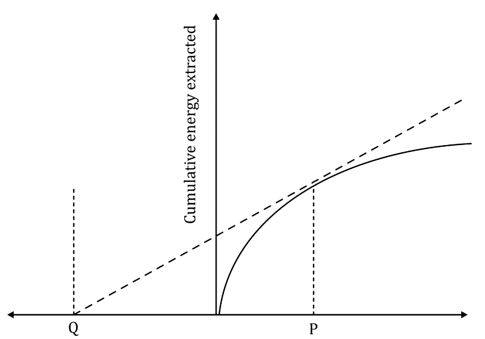
Point P represents the optimum patch residence time, i.e., the time an animal should stay in the patch to maximize net energy gain. Staying beyond this point reduces efficiency.
Point Q represents the time taken to travel between patches, which influences the optimal residence time (longer travel time → longer stay in patch).
The slope of the tangent at P corresponds to the average rate of energy gain, balancing time spent traveling and foraging.
Information Booster:
The Marginal Value Theorem (Charnov, 1976) predicts that animals should leave a resource patch when the instantaneous rate of resource gain falls below the average rate for the environment.
Travel time between patches affects how long an animal should stay in a patch; longer travel means longer stays to maximize energy efficiency.
This theory is fundamental in behavioral ecology and optimal foraging theory.