






Correct option is C
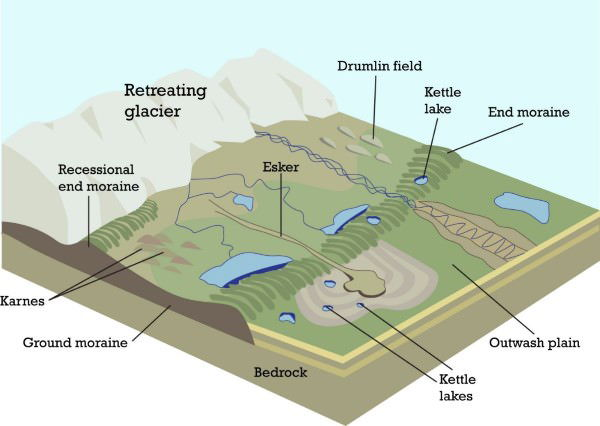
Hummocks are low, irregular mounds or small hills found in areas affected by glacial activity. They are often associated with kettles, which are depressions formed when blocks of ice are buried by sediment and later melt. As the ice melts, the overlying material collapses, creating a landscape of mounds (hummocks) and hollows (kettles). These features typically occur in glaciated regions and can vary in size and distribution.
Information Booster:
· Hummocks are low, irregular mounds or knolls commonly found in landscapes shaped by glacial activity. They are associated with kettles, which form when large blocks of glacial ice are buried by sediments and later melt, causing the ground above to collapse.
· Formation: Hummocks develop from the uneven deposition of glacial till and debris over a melting ice surface, creating a bumpy terrain of mounds and depressions.
· Location: They are typically found in glaciated regions, especially where stagnant ice has left a complex terrain.
· Characteristics: These mounds vary in size and distribution, with some forming small clusters and others appearing as isolated hills.
Additional Knowledge:
Kame: These are formed as glacial ice melts, leaving behind sediments that accumulate in depressions. They often appear as isolated hills. Key Point: Common in glacial outwash plains.
Drumlin: These are streamlined in shape and indicate past ice flow. Key Point: Their alignment provides valuable information about glacial movement.
Esker: Eskers are significant in studying ancient glacial hydrology. Key Point: They indicate the presence of subglacial tunnels.
 English
 10 Questions
 20 Marks
 12 Mins


