






Correct option is D
The correct answer is 4. A, B, and C.
Explanation:
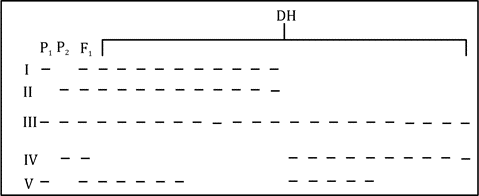
The problem involves analyzing AFLP (Amplified Fragment Length Polymorphism) bands observed in parents (P₁ and P₂), F₁ progeny, and 20 doubled haploid (DH) progeny created through chromosome doubling of pollen grains. The bands are labeled I, II, III, IV, and V, and we need to evaluate the statements about these bands.
Conclusion:
All three statements (A, B, and C) are correct based on the observed AFLP band patterns. Therefore, the combination of all correct statements is represented by option 4 (A, B, and C).
- A. Bands I and IV are allelic.
- Bands I and IV show a pattern where one parent (P₁) has band I, the other (P₂) has band IV, the F₁ has both, and the DH progeny segregate for either I or IV. This indicates that I and IV are allelic variants at the same locus, inherited in a Mendelian fashion. This statement is correct.
- B. Bands II and V assort independently.
- Bands II and V show different segregation patterns in the DH progeny. Band II is present in some DH lines and absent in others, while band V shows a separate pattern of presence and absence, with no consistent linkage between the two. This suggests that the loci for bands II and V are on different chromosomes or far apart on the same chromosome, leading to independent assortment. This statement is correct.
- C. Band III is uninformative.
- Band III is present in both parents (P₁ and P₂), the F₁, and all DH progeny. Since there is no variation in the presence of band III across the progeny, it does not provide any information about segregation or linkage. This makes it uninformative for genetic mapping or analysis. This statement is correct.


