

Correct option is B
Explanation -
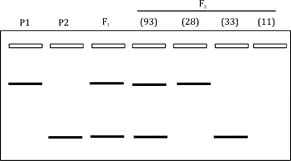
P1: Single lower band.
P2: Single upper band.
F1: Both upper and lower bands.
F2 progeny: Four profiles:
Both bands (like F1) — 93 individuals
Upper band only (like P2) — 28 individuals
Lower band only (like P1) — 33 individuals
No bands at all — 11 individuals
Four phenotypic classes in F₂, including “no band,” suggests that two different loci (genes) are segregating independently.
If only one locus with co-dominant alleles was involved:
F2 would show only three types:
Homozygous P1 (one band)
Homozygous P2 (other band)
Heterozygous (both bands)
But here we see four profiles, including a case where no band is observed — which cannot happen in a simple one-locus scenario.
Therefore:
The only explanation for:
Individuals with only one band , individuals with both bands and individuals with no band is that each band is controlled by a separate, independently assorting gene.
So, the correct answer is option b - The polymorphic DNA bands represent two independent genes.
Incorrect options-
Option a: Co-dominant DNA markers were used for this study.
Co-dominant markers would produce three phenotypes in F2:
Band from one parent
Band from the other
Both bands in heterozygotes
We see 4 phenotypes, including one with no bands at all, which cannot occur with a single co-dominant marker. The presence of an individual with no bands implies that both loci are segregating independently, and the individual is homozygous null for both markers.
This is incorrect because co-dominance alone doesn’t explain 4 banding patterns, especially the “no band” type.
Option c: If the P1 parent was crossed to the F1 individual, the progeny will show all four profiles as observed in the case of F₂ progeny.
P1 × F1 cross = test cross.
Genotype of P1 = aa bb (homozygous recessive at both loci)
Genotype of F1 = Aa Bb
The resulting progeny from this cross will show only two types of alleles per locus, so the number of combinations is limited.
There are only two or three banding patterns, not all four observed in F2 (which is from selfing of F1 and shows a full 9:3:3:1 type segregation).
This is incorrect because P1 × F1 cannot yield all four banding patterns.
Option d: If an F₂ progeny which does not show either of the DNA markers is crossed to a P1 individual, the obtained progeny will have two types of individual, one which shows a band and the other where no band is observed.
The F2 individual with no bands must be homozygous null at both loci (i.e., aa bb).
P1 also shows only the lower band, so it must be aa BB.
Cross: aa bb × aa BB → All progeny = aa Bb
This means all offspring will inherit the lower band only (from P1), and none will have the upper band or be bandless.
This is incorrect because this cross will produce a single banding type, not two.