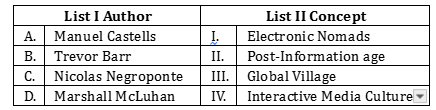
Correct option is D
The Aristotle model of communication, one of the earliest and simplest models, focuses on the speaker delivering a message to the audience. However, it has notable limitations:
1. One-way communication (C): The model does not allow for feedback, making it unidirectional. This hinders interactive communication and audience participation.
2. Stress on the speaker (D): The model overemphasizes the role of the speaker while neglecting the audience’s active involvement. This can burden the speaker to ensure the message’s effectiveness.
3. Ignorance of noise (E): It fails to account for barriers (or noise) that may distort the message during communication, such as misunderstandings or environmental distractions.
Information Booster 1. Developed by Aristotle, this model primarily suits public speaking and persuasive communication.
2. The components include Speaker, Speech, and Audience, with the speaker as the central figure.
3. The model works well in structured settings like political speeches or debates but is inadequate for two-way dialogue.
4. It does not address modern communication factors like cultural differences, feedback loops, or digital mediums.
5. Contemporary models (e.g., Shannon-Weaver) expanded on its limitations by including feedback and noise.
Additional Knowledge
(A) Weak encoding: Incorrect. Encoding (the formulation of the message) is not inherently weak in Aristotle’s model but depends on the speaker's skill.
(B) Audience created content: Incorrect. This is irrelevant to Aristotle’s model, which focuses solely on the speaker delivering the message.
 English
 10 Questions
 20 Marks
 12 Mins