
Correct option is C
William Stern coined/devised the concept of Intelligence Quotient (IQ) in 1912.
Basic information about the topic: Intelligence Quotient (IQ) is a standardized measure designed to assess human cognitive abilities and intellectual potential relative to age norms.
Information Booster: Explanation of the correct answer in pointers in detail
·
Origin of the Term: The concept and term
Intelligence Quotient (IQ) were originally introduced and coined by the German psychologist
William Stern in
1912.
·
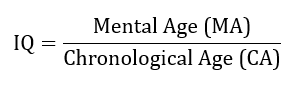
Original Formula by Stern: Stern defined IQ as the ratio of a person's mental age to their chronological (actual) age:
·
Refinement by Lewis Terman: While Stern devised the ratio formula, it was American psychologist
Lewis Terman of Stanford University who later
multiplied this quotient by 100 (giving the modern formula: IQ = MA/CA x 100 while developing the
Stanford-Binet Intelligence Scale in 1916.
·
Contribution to Psychometrics: Stern's quotient provided a groundbreaking standardized method to compare cognitive development across children of varying biological ages.
Additional Knowledge:
Explanation of the other options apart from the correct statements
·
William James:
·
Why it is not correct:
William James is widely recognized as the
"Father of American Psychology" and a pioneer of the psychological school of
Functionalism.
· He authored the influential text The Principles of Psychology (1890) and studied consciousness, pragmatism, and emotion, but he did not develop or coin intelligence quotient metrics.
·
William Wundt (Wilhelm Wundt):
·
Why it is not correct:
Wilhelm Wundt is celebrated as the
"Father of Experimental Psychology" for establishing the world's first formal psychology laboratory in
Leipzig, Germany (1879).
· His work focused primarily on
Structuralism, introspection, and sensory perception, rather than mental testing or intelligence measurement.
·
William Blake:
·
Why it is not correct:
William Blake was an iconic
English Romantic painter, poet, and printmaker from the late 18th and early 19th centuries (famous for works like Songs of Innocence and Experience).
· He had no connection to educational psychology, psychometrics, or cognitive testing.
 English
 10 Questions
 20 Marks
 12 Mins


