Correct option is A
The case of
Tweddle vs. Atkinson (1861) is a landmark English contract law case that is primarily associated with the doctrine of
privity of contract. This doctrine establishes that only the parties involved in a contract have the right to enforce the terms of the contract, and third parties who are not part of the agreement cannot sue for benefits under it, even if the contract was intended to benefit them.
Information Booster In
Tweddle vs. Atkinson, the facts were as follows: Two fathers (one of the bride and one of the groom) entered into an agreement to pay a sum of money to the groom. When one of the fathers failed to fulfill the promise, the groom sued the executor of the estate. The court held that the groom could not enforce the contract because he was not a party to it, despite being the intended beneficiary. This case clearly established the principle that a third party who is not a party to a contract cannot sue to enforce it, even if they stand to benefit from it.
Additional Knowledge Let’s briefly explain why the other options do not apply:
·
(b) General offer: A general offer is an offer made to the public at large, which anyone can accept. The famous case for a general offer is
Carlill v Carbolic Smoke Ball Co., not
Tweddle vs. Atkinson.
·
(c) Impossibility of performance: This refers to situations where it becomes impossible to fulfill a contract. A notable case on this topic is
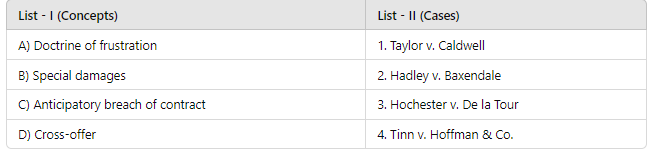
Taylor v Caldwell. It does not relate to the
Tweddle vs. Atkinson case.
·
(d) Anticipatory Breach of Contract: This occurs when one party indicates in advance that they will not perform their contractual obligations. This concept is not related to the
Tweddle vs. Atkinson case.