Correct option is B
Sol.
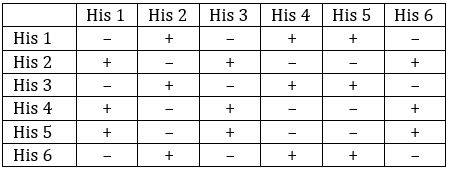
Complementation occurs when two mutants with mutations in different genes are fused, resulting in a histidine prototrophic diploid (+).
No complementation (no growth, ‘-’) indicates mutations in the same gene.
From the table:
His1, His3, His6 show no complementation with each other (‘-’), so these are likely mutations in the same gene (Gene 1).
His2, His4, His5 complement His1/3/6 but do not complement each other (negative among themselves), indicating a second gene (Gene 2).
Therefore, the six mutants represent two different genes.
Information Booster:
This is a classic complementation test used to determine if mutations affect the same or different genes.
Complementation group refers to a set of mutations in the same gene.
This method was fundamental in early genetic mapping and gene discovery.