






Correct option is B
X: The second smallest number of set A = The second smallest number of set B.
Possible values = 30, 60 and 90.
Take 30
Set A: 25, 30, 35, 40, 45, 50
Set B: 24, 30, 36
Take 60
Set A: 55, 60, 65, 70, 75, 80
Set B: 54, 60, 66
Take 90
Set A: 85, 90, 95, 100, 105, 110
Set B: 84, 90, 96
Set A = Two-digit number
So, can’t takes 90
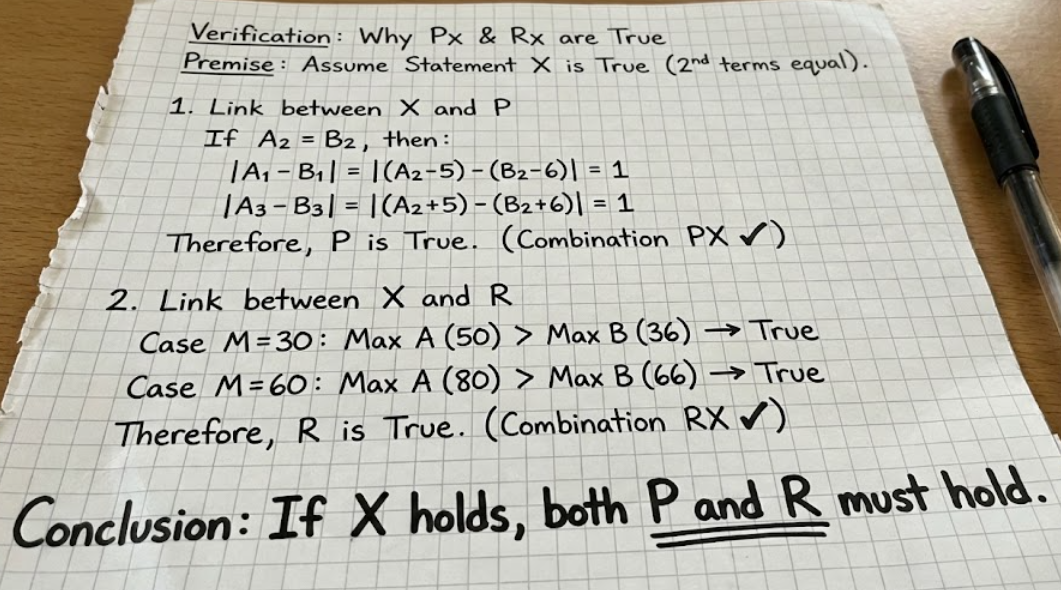
P: The difference between the smallest number of set A and set B is equal to the difference between the 3rd smallest number of set A and set B.
We take PX
The difference between the smallest number of set A and set B = 55 – 54 = 1 or 25 – 24 = 1
The difference between the 3rd smallest number of set A and set B = 36 – 35 =1 or 66 – 65 = 1
It is true.
Q: One of the number in set B is 36.
We take RX
Take 60
Set A: 55, 60, 65, 70, 75, 80
Set B: 54, 60, 66
It is false.
R: The largest number of set A is greater than the largest number of set B.
We take RX
50 > 36 and 80 > 66
it is true.
Y: Sum of the largest numbers of set A and set B is 146.
We take PY and QY
So many possibilities there
The combinations are definitely true is PX and RX.
Exam Hall Method:
 English
 35 Questions
 35 Marks
 20 Mins


