

hamburger menu
All Coursesall course arrow
adda247
reward-icon
adda247
    arrow
    arrow
    arrow
    Protein ‘A’ was subjected to different experiments:i) SDS-PAGE with/without β-mercaptoethanol (β-ME) ii) Fluorescence iii) Far-UV iv) Near-UV CD spect
    Question

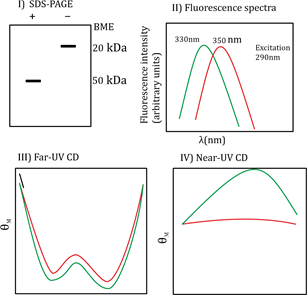
    Protein ‘A’ was subjected to different experiments:

    i) SDS-PAGE with/without β-mercaptoethanol (β-ME)
    ii) Fluorescence
    iii) Far-UV
    iv) Near-UV CD spectra at pH 7.0 (blue) and 3.0 (red)

    The results are shown below:

    Which one of the following options provides the correct inference?

    A.

    Protein ‘A’ is an S-S bonded homotetramer and each subunit has a molecular mass of 50 kDa, folded at pH 7.0 and molten globule at pH 3.0.

    B.

    Protein ‘A’ has a molecular mass of 200 kDa, βME degrades the protein, low pH changes the conformation from α helix to β sheet.

    C.

    SDS denatures protein ‘A’ into different oligomeric states, low pH changes the conformation from α helix to β sheet.

    D.

    SDS promotes the formation of different oligomeric states of Protein ‘A’, low pH changes the conformation from β sheet to α helix.

    Correct option is A

    The SDS-PAGE data with and without 8-mercaptoethanol (B-ME) shows a difference in molecular mass bands indicating that the protein contains disulfide bonds (S-S bonded). Without B-ME, the band corresponds to 100 kDa, and with B-ME it breaks into 50 kDa subunits, indicating that the protein is a homodimer linked by disulfide bonds. The fluorescence spectra at pH 7.0 and 3.0 show slight shifts, indicating changes in tertiary structure but not complete unfolding. The Far-UV CD spectra show typical α-helical characteristics at pH 7.0 which slightly change at pH 3.0 but do not convert into β-sheet structure. Near-UV CD indicates tertiary structure changes upon pH change but not a complete loss of folding. This suggests the protein forms a molten globule state at acidic pH 3.0.

    Hence, the correct interpretation is that protein ‘A’ is an S-S bonded homodimer with subunits of 50 kDa, folded at neutral pH, and exists as a molten globule at acidic pH.

    Additional Information:

    • Option (b): Incorrect because the protein is a 100 kDa dimer, not a 200 kDa monomer, and there is no evidence of α helix to β sheet conversion from CD data.

    • Option (c): Incorrect because SDS denatures proteins but here it’s not causing oligomerization states; also, pH does not convert α helix to β sheet.

    • Option (d): Incorrect as SDS does not promote oligomeric states in this context, and the conformational change is from folded to molten globule, not β sheet to α helix.

    Similar Questions

    test-prime-package

    Access ‘CSIR NET Life Sciences’ Mock Tests with

    • 60000+ Mocks and Previous Year Papers
    • Unlimited Re-Attempts
    • Personalised Report Card
    • 500% Refund on Final Selection
    • Largest Community
    students-icon
    354k+ students have already unlocked exclusive benefits with Test Prime!
    test-prime-package

    Access ‘CSIR NET Life Sciences’ Mock Tests with

    • 60000+ Mocks and Previous Year Papers
    • Unlimited Re-Attempts
    • Personalised Report Card
    • 500% Refund on Final Selection
    • Largest Community
    students-icon
    354k+ students have already unlocked exclusive benefits with Test Prime!
    Our Plans
    Monthsup-arrow
