Correct option is B
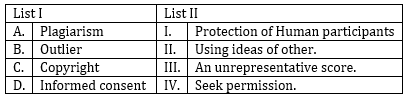
A. Plagiarism: Plagiarism refers to
using ideas of others without proper attribution, which is a violation of academic and ethical standards. Therefore, the correct match is
A-II.
·
B. Outlier: An
outlier is an
unrepresentative score that significantly deviates from other data points in a dataset, potentially skewing results. Hence,
B-III is correct.
·
C. Copyright: Copyright involves the
protection of intellectual property. This includes ensuring that authors and creators retain control over their work. Thus,
C-IV is correct.
·
D. Informed consent:
Informed consent is the process of ensuring that participants in a study are fully aware of what it involves, and that they
seek permission before participating. Therefore,
D-I is correct.
Information Booster:
1.
Plagiarism (A-II): Plagiarism can be intentional or unintentional, but it is still a breach of ethical and academic standards. It involves copying text, data, or ideas from another source without proper citation or permission.
2.
Outlier (B-III): Outliers are extreme values that fall far outside the range of the data. While outliers can sometimes indicate errors, they can also provide valuable insights when properly examined.
3.
Copyright (C-IV): Copyright laws protect original works of authorship, including literature, music, and art. It prevents unauthorized reproduction or use of the work.
4.
Informed Consent (D-I): Informed consent is crucial in research to protect participants' rights. Researchers must inform participants about the purpose, procedures, risks, and benefits of the study, ensuring voluntary participation.
Additional Information:
·
Plagiarism (A-II): Besides academic consequences, plagiarism can also have legal ramifications, especially if the plagiarized material is copyrighted.
·
Outlier (B-III): Identifying outliers is essential in data analysis, as they can significantly affect statistical conclusions.
·
Copyright (C-IV): Copyright infringements can lead to legal actions, fines, or restrictions on the use of creative work.
·
Informed Consent (D-I): It is a fundamental principle of ethical research, ensuring participants are not coerced and are fully aware of their rights.
 English
 150 Questions
 150 Marks
 150 Mins