






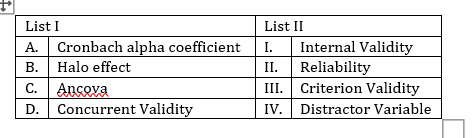
Correct option is B
A. Cronbach alpha coefficient → II. Reliability: The Cronbach alpha coefficient is a measure used to assess the reliability (internal consistency) of a test or scale. It is a commonly used statistic to evaluate how consistently a test measures what it is intended to measure.
B. Halo effect → I. Internal Validity: The Halo effect is a cognitive bias where a person’s overall impression of someone influences their feelings and thoughts about that person's specific traits. This effect can affect the internal validity of an experiment because it can introduce bias in judgments and ratings, thus impacting the accuracy of the results.
C. Ancova → IV. Distractor Variable: ANCOVA (Analysis of Covariance) is a statistical method that combines analysis of variance (ANOVA) with regression. It is used to control for distractor variables or covariates that might influence the dependent variable, allowing for a clearer analysis of the primary relationships being studied.
D. Concurrent Validity → III. Criterion Validity: Concurrent validity is a type of criterion validity that assesses the extent to which a test or measure correlates with an established standard or criterion at the same point in time. It is used to verify that the new test measures what it is supposed to measure by comparing it with a similar, already validated test.
Information Booster:
Cronbach alpha coefficient is specifically used for assessing reliability and is often used to test the consistency of items in a scale.
Halo effect can significantly affect internal validity by introducing a bias that affects how subjects are rated or judged.
ANCOVA helps to eliminate the influence of distractor variables (or covariates) that could affect the outcome of an experiment, allowing for more accurate results.
Concurrent validity is a form of criterion validity, used to validate tests by comparing them to pre-existing, widely accepted measures.
Additional Information:
Reliability is concerned with consistency and stability, while validity refers to how well a test measures what it intends to measure.
Halo effect is just one example of biases that can affect internal validity in an experiment.
ANCOVA helps control for variables that are not the primary focus of the study but could still influence the results.
Criterion validity involves both concurrent validity and predictive validity, helping to ensure that the test is relevant to real-world outcomes.
 English
 10 Questions
 20 Marks
 12 Mins


