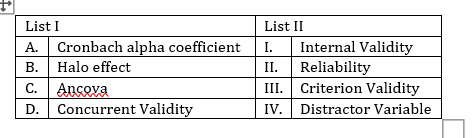
Correct option is C
Repeated-measures designs involve the same participants being exposed to multiple conditions or measurements. While this design has many advantages, such as reducing variability between subjects, several problems can arise:
Carryover effect (A):
This occurs when the effects of one condition influence the next condition, which can distort results. For example, if participants perform a task in one condition, their performance in the next condition may be affected by their previous experience.
Fatigue (C):
As participants are exposed to multiple conditions, they may become fatigued over time, leading to poorer performance in later conditions. This is a common issue in repeated-measures designs, especially in lengthy experiments.
Sensitization (D):
Sensitization refers to the idea that participants may become more aware of the experimental manipulation over time, affecting their responses in subsequent conditions. For example, after completing one task, participants might become more attuned to the nature of the experiment, which can bias their responses.
The other options are:
Interpersonal effect (B):
This refers to how interactions between participants may influence results, but it is not typically a concern specific to repeated-measures designs. Interpersonal effects are more of a concern in group designs or where social dynamics play a role.
Factorial effect (E):
This is not an issue related to repeated-measures designs. A factorial design refers to experiments where multiple factors are manipulated to examine their combined effects, but it is a general design issue, not a specific problem with repeated measures.
 English
 10 Questions
 20 Marks
 12 Mins